
Here’s a question most people never stop to ask: why do you have to pay taxes this year on money you won’t spend for 30 years?
The tax code actually agrees that’s a fair point — which is why the Traditional IRA exists.
A Traditional IRA lets you invest money now, skip the taxes on that contribution today, and let the entire balance grow without the IRS touching it until you start making withdrawals in retirement. That delay can be worth thousands of dollars. Here’s how it all works.
What Is a Traditional IRA?
A Traditional IRA is an individual retirement account you open yourself, independent of any employer. “IRA” stands for Individual Retirement Account. “Traditional” distinguishes it from the Roth IRA, which works on opposite tax logic.
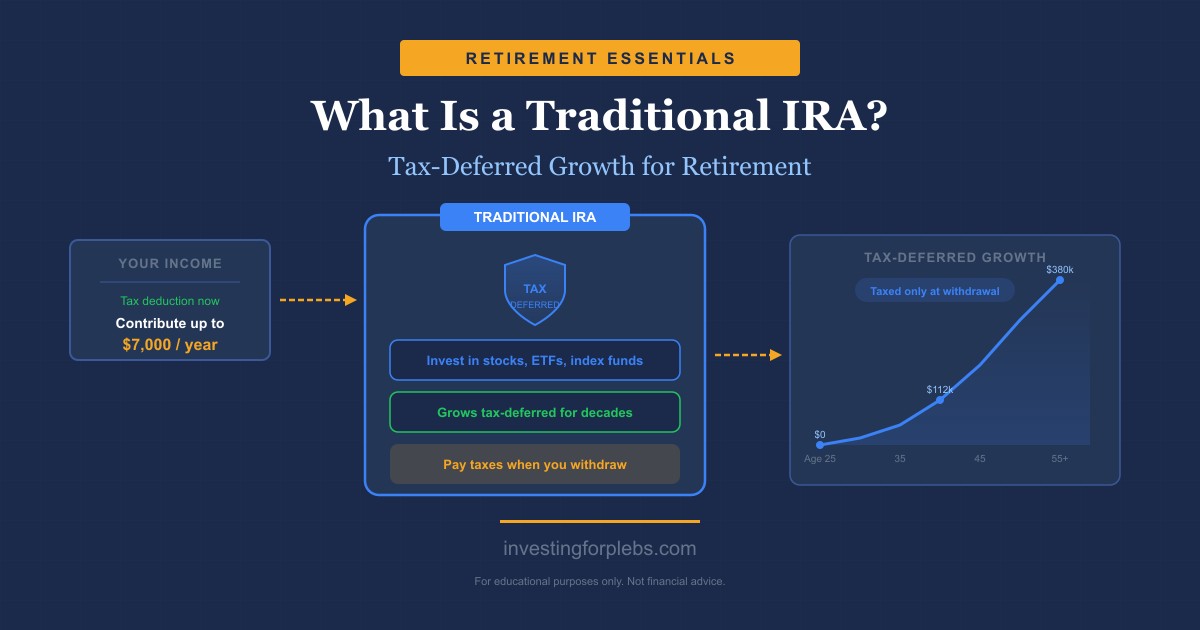
The defining feature of a Traditional IRA is tax deferral: you may be able to deduct your contributions from your taxable income today, your money grows inside the account without being taxed annually, and you pay ordinary income taxes when you eventually take the money out in retirement.
In plain terms: you get a tax break now, and pay taxes later.
How a Traditional IRA Works
The flow is straightforward:
- You earn income and make a contribution to your Traditional IRA (up to the annual limit).
- If you’re eligible, you deduct that contribution from your taxable income on your tax return.
- You invest the money inside the account — in stocks, ETFs, index funds, or other eligible assets.
- The money grows tax-deferred. No taxes on gains, dividends, or interest while it sits in the account.
- Starting at age 59½, you can begin making withdrawals. Each withdrawal is taxed as ordinary income in the year you take it.
The deferral is the key. Instead of paying taxes on that income this year, you delay the tax bill potentially for decades — and the money that would have gone to taxes keeps compounding for you instead.
The Tax Advantage, With a Real Example
Let’s make this concrete.
Say you’re in the 22% federal income tax bracket. You have $6,000 you want to invest for retirement.
Without a Traditional IRA: You’ve already paid taxes on that money as regular income. You invest $6,000 after-tax in a standard brokerage account. Each year, your dividends are taxed, and capital gains are taxed when you sell. Over 30 years, the tax drag reduces your compounding.
With a Traditional IRA (fully deductible): You contribute $6,000 and deduct it from your taxable income. That deduction saves you $1,320 on this year’s tax bill (22% × $6,000). You effectively got a $6,000 investment for $4,680 out of pocket this year. The full $6,000 then compounds tax-deferred for decades. You pay taxes when you withdraw in retirement — but if you’re in a lower bracket then, the math works in your favor.
For more on why compound growth over decades is so powerful, our compound interest explainer shows the numbers in plain terms.
2026 Contribution Limits
The IRS sets annual limits on how much you can put into a Traditional IRA.
For 2026, the contribution limit is $7,000 per year. If you’re age 50 or older, you can add an extra $1,000 as a “catch-up contribution,” bringing your total to $8,000.
A few important rules:
- Combined limit across IRAs. If you have both a Traditional and a Roth IRA, the $7,000 cap applies to both accounts combined, not to each separately.
- Earned income required. You can only contribute up to the amount you earned from work that year. If you earned $4,500, your maximum is $4,500.
- Contribution deadline. You have until Tax Day (usually April 15) to make contributions for the prior tax year.
IRS contribution limits are adjusted periodically for inflation. Always verify current-year limits at irs.gov.
Who Can Contribute?
Anyone with earned income can contribute to a Traditional IRA. There are no income limits on who can contribute — the income limits only affect whether your contribution is tax-deductible.
Earned income includes wages, salaries, self-employment income, and tips. It doesn’t include investment income, rental income, or Social Security benefits.
One exception: if you have no earned income but your spouse does, you may be able to contribute to a Spousal IRA based on your spouse’s earnings, as long as you file a joint return.
Tax Deductibility: The Income Rules
Here’s where it gets slightly nuanced. Whether your Traditional IRA contribution is tax-deductible depends on whether you (or your spouse) are covered by a retirement plan at work — like a 401(k).
If neither you nor your spouse has a workplace retirement plan: Your Traditional IRA contributions are fully deductible, regardless of your income. This is the simplest scenario.
If you have a workplace retirement plan: The deductibility phases out above certain income levels.
For 2026 (approximate — verify at irs.gov):
| Filing Status | Deduction phases out | No deduction above |
|---|---|---|
| Single or Head of Household | ~$79,000 | ~$89,000 |
| Married Filing Jointly (you’re covered at work) | ~$126,000 | ~$146,000 |
| Married Filing Jointly (spouse is covered, you’re not) | ~$236,000 | ~$246,000 |
If your income falls in the phase-out range, you can still contribute — you just get a partial deduction. Above the top threshold, you can still contribute to a Traditional IRA, but contributions are non-deductible.
Non-deductible Traditional IRA contributions are still useful for tax-deferred growth, but it requires more paperwork (IRS Form 8606) to track the basis. If your income is above these thresholds, also look at the Roth IRA as an alternative.
Traditional IRA vs. Roth IRA
Both are individual retirement accounts you open yourself. The main difference is the tax timing.
| Traditional IRA | Roth IRA | |
|---|---|---|
| Contributions | May be tax-deductible | After-tax (no immediate deduction) |
| Growth | Tax-deferred | Tax-free |
| Withdrawals in retirement | Taxed as ordinary income | Tax-free |
| Required minimum distributions | Starting at age 73 | None during your lifetime |
| Income limits to contribute | No income limit (deductibility has limits) | Yes — phases out at higher incomes |
| Early withdrawal penalty | Taxes + 10% on entire amount | 10% only on earnings (contributions are penalty-free) |
The core decision: do you expect your tax rate to be higher now or in retirement?
- If you expect to be in a lower tax bracket in retirement, a Traditional IRA is usually better. You defer taxes from your high-earning years and pay them later at a lower rate.
- If you expect to be in a higher bracket in retirement (or the same bracket), a Roth IRA is usually better. You pay taxes now and lock in tax-free withdrawals.
For most early-career investors in relatively low brackets, the Roth IRA is the stronger default. For mid-to-high earners in their peak earning years who expect a significant income drop in retirement, the Traditional IRA’s deduction can be genuinely valuable. Our full comparison guide on Roth IRA vs. Traditional IRA walks through the trade-offs in more depth.
Required Minimum Distributions (RMDs)
This is the one major catch with a Traditional IRA that the Roth IRA doesn’t have.
Starting at age 73, the IRS requires you to withdraw a minimum amount from your Traditional IRA each year. This is called a Required Minimum Distribution (RMD). You can’t just leave the money growing in the account forever — the government wants its taxes eventually.
The annual RMD amount is calculated based on your account balance and life expectancy tables published by the IRS. If you don’t take the required distribution, the penalty is steep: 25% of the amount you should have withdrawn (reduced to 10% if corrected quickly).
This mandatory withdrawal schedule can affect your retirement income planning — and it’s one reason some investors prefer the Roth IRA, which has no RMD requirement during your lifetime.
Traditional IRA vs. 401(k)
If you have access to a 401(k) at work, how does it stack up against a Traditional IRA?
| Traditional IRA | Traditional 401(k) | |
|---|---|---|
| Who opens it | You (at any brokerage) | Your employer |
| Contribution limit | $7,000/year | $23,500/year |
| Employer match | None | Often available |
| Investment options | Anything your brokerage offers | Limited to your employer’s plan menu |
| Control | Full | Limited to plan options |
The practical order of operations for most people: capture your full 401(k) employer match first (it’s a guaranteed 100% return on those dollars — nothing beats that), then consider maxing out an IRA, then go back to maxing the 401(k) if you can.
The 401(k)’s higher contribution limit and potential employer match make it a priority. The IRA’s flexibility and broader investment options make it a valuable complement.
When a Traditional IRA Makes the Most Sense
A Traditional IRA is worth prioritizing when:
- You’re in a high income tax bracket today and expect to be in a lower bracket in retirement
- You don’t have access to a 401(k) or other employer plan
- You’ve already maxed out your 401(k) and want additional tax-deferred space
- You’re self-employed and want the current-year deduction to reduce taxable income
- You’re approaching retirement (50+) and want to catch up while still working
If you’re early in your career and currently in a low tax bracket, the Roth IRA often wins on expected lifetime tax savings. The Traditional IRA becomes more attractive as your income rises.
How to Open a Traditional IRA
Opening a Traditional IRA takes about 15 minutes:
- Choose a brokerage. Any major online brokerage — Fidelity, Schwab, Vanguard, or others — offers Traditional IRAs with no account minimums and access to low-cost index funds. Our How to Open a Brokerage Account guide walks through what to look for.
- Select “Traditional IRA” as your account type when opening the account.
- Fund it. Link your bank account and contribute. You can contribute all at once or spread contributions throughout the year. Automating monthly contributions is the easiest way to build the habit.
- Invest the money. This is the step people miss. Money sitting in a Traditional IRA uninvested earns almost nothing. Choose your investments — low-cost index funds and ETFs are a sensible starting point for most people.
- Track your deductibility. If your contributions are non-deductible (because your income is above the phase-out), file IRS Form 8606 to record your basis. This prevents you from paying taxes on those contributions a second time when you withdraw.
Common Traditional IRA Mistakes
Forgetting to actually invest the money. Contributions that sit in cash inside the account aren’t growing. Pick your investments.
Missing the contribution deadline. You can make contributions for the prior tax year up until Tax Day. Many people don’t realize they can fund their 2026 IRA as late as April 15, 2027.
Not tracking non-deductible contributions. If you contribute without a deduction, that money isn’t taxed again at withdrawal — but only if you filed Form 8606 to establish your basis. Without it, you’ll pay taxes twice.
Withdrawing early. Withdrawals before age 59½ typically trigger income taxes plus a 10% penalty. Unlike a Roth IRA, you can’t pull out your original contributions penalty-free. Plan to leave this money alone until retirement.
Ignoring the RMD clock. At age 73, you must start taking distributions. Build this into your retirement income planning well in advance — especially if you have other income sources and want to manage your taxable income strategically.
The Bottom Line
The Traditional IRA is a powerful retirement savings tool for the right investor. If you’re in a high tax bracket today and expect lower income in retirement, the upfront deduction and decades of tax-deferred compounding can translate to meaningful real money.
The key is understanding the trade-offs: you’re borrowing from the future tax bill, not eliminating it. Plan accordingly — and start early, because time is the one ingredient that makes every retirement account work.
This content is for educational purposes only and does not constitute financial advice. investingforplebs.com is not a registered investment advisor. Please consult a qualified financial professional before making investment decisions.



Leave a Reply