
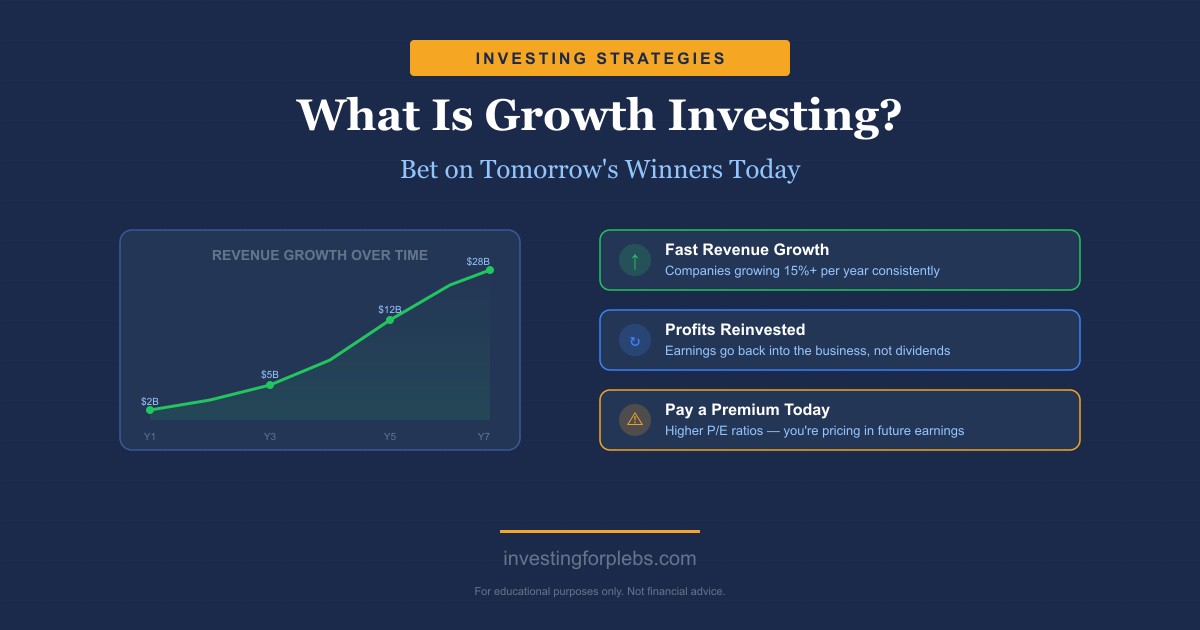
TL;DR: Growth investing is the strategy of buying shares in companies that are growing revenue and earnings faster than the market average, then holding while that growth compounds into returns. You pay a premium today because you believe the business will be significantly bigger tomorrow.
You’ve probably heard of Amazon, Apple, or Nvidia. Each seemed expensive for years, yet kept going up. Growth investing is the philosophy behind that kind of bet.
The idea is simple: find businesses that are expanding quickly, buy in before the growth becomes obvious to everyone, and ride the compounding over time. You’re not looking for bargains. You’re looking for momentum, market opportunity, and businesses that reinvest every dollar they earn into getting bigger.
What Is Growth Investing?
Growth investing is a strategy focused on companies that are increasing their revenue, earnings, or both at an above-average rate. Instead of hunting for undervalued stocks (that’s value investing), growth investors are willing to pay a premium for businesses they believe have room to run.
The trade-off is explicit: growth stocks often look expensive by traditional metrics. Their P/E ratios are high. They might not pay dividends. They reinvest every dollar back into the business. But if the company keeps growing the way you expect, that premium can look cheap in hindsight.
Think of it as buying a small store that’s expanding into a national chain. The asking price is high relative to today’s profits. But you’re not paying for today — you’re paying for what it becomes.
What Do Growth Investors Look For?
Growth investors aren’t just buying companies with high stock prices. They’re looking for specific signals that sustainable, above-average growth is likely to continue.
Revenue growth rate. How fast is the top line growing? Many growth investors want to see 15–25%+ year-over-year revenue growth, though expectations vary by industry. The pace matters more than the absolute number.
Earnings acceleration. Even better than steady growth is accelerating growth: quarters where revenue and earnings growth is getting faster, not slower. Acceleration signals that something is working.
Total addressable market (TAM). A company growing at 30% per year inside a tiny market has a ceiling. Growth investors want big markets: the company should have room to keep expanding for years before it runs out of new customers or territory.
Competitive moat. Fast growth attracts competition. Growth investors look for a reason competitors can’t just copy the model: network effects, switching costs, proprietary technology, brand loyalty. See return on equity for one way to measure whether a moat is showing up in the numbers.
Management quality. Growth companies often reinvest aggressively instead of returning cash to shareholders. That makes management trust crucial: you need to believe they’re allocating capital well and building toward something real.
What Do Growth Stocks Look Like?
Growth stocks tend to share a few common traits that set them apart from the broader market.
High P/E ratios. A growth stock might trade at 40, 60, or even 100 times earnings. That sounds scary, but the logic is that future earnings justify the current price. The risk is that if growth slows, that premium collapses fast.
Low or no dividends. Growth companies rarely pay dividends. Every dollar of profit gets plowed back into hiring, R&D, product development, or expansion. Dividends vs growth stocks is a whole separate conversation, but the short version: growth investors are betting on price appreciation, not income.
Larger market capitalizations in high-growth sectors. Technology, healthcare, consumer discretionary, and more recently clean energy and AI tend to produce the most growth stocks. These sectors have large addressable markets and are often still in early stages of disruption. (Here’s a primer on what market capitalization means.)
Earnings that lag revenue. Early-stage growth companies often post thin margins or even losses as they invest in expansion. Investors are buying the potential of future profitability, not current earnings. Amazon ran at breakeven for years while building the infrastructure that now generates billions.
The Pros and Cons of Growth Investing
What makes it attractive:
- Compounding returns. If you buy early into a company that 10x’s, the compounding math is hard to match with any other strategy.
- High upside. A well-chosen growth stock can outperform the market by a wide margin over a multi-year hold.
- Participation in innovation. Growth investing often means owning the businesses reshaping how industries work.
What makes it hard:
- Volatility. Growth stocks can fall 40–60% in a bad market cycle or after a disappointing earnings report. High valuations mean there’s a long way to drop.
- Valuation risk. You’re paying for expectations. If the company misses its growth targets, the market reprices aggressively.
- Harder to analyze. Value stocks are cheap for a reason that’s visible in the financials. Growth stocks require you to forecast what a business could become, and that forecasting is genuinely difficult.
- Rate sensitivity. When interest rates rise, the present value of future earnings gets discounted more heavily. Growth stocks, which trade on future earnings, tend to suffer more in rising-rate environments than value stocks.
Growth Investing vs Value Investing
The classic debate in investing comes down to this: would you rather buy a great company at a fair price, or a fair company at a great price?
Growth investing leans toward the first option. You’re willing to pay a full (or even rich) price for a business with exceptional prospects. Value investing, by contrast, focuses on buying companies that are temporarily out of favor at a discount to what they’re actually worth.
Neither approach wins all the time. Growth stocks dominated from roughly 2010 to 2021, a period of low interest rates that inflated future-earnings valuations. When rates rose sharply starting in 2022, value stocks recovered ground. Over very long time horizons, the two approaches have been more comparable than the headlines suggest.
Many investors don’t pick a side. A blended approach (owning a core of low-cost index funds alongside selected growth positions) lets you participate in high-growth upside without betting the portfolio on it.
How Can a Beginner Start Growth Investing?
If you’re new to this, start with funds before individual stocks.
Growth ETFs. Funds like the Vanguard Growth ETF (VUG) or iShares Russell 1000 Growth ETF (IWF) give you broad exposure to large-cap growth companies in one trade, with low fees and instant diversification. You get the category without needing to pick the winners yourself.
Research before you buy individual stocks. If you want to own specific companies, do the work first: read recent earnings calls, understand the revenue growth trajectory, check the P/E and compare it to peers, and honestly assess the competitive position. Don’t buy a growth stock just because it’s gone up.
Size your positions accordingly. Growth stocks are volatile. Consider how much of your portfolio you’re comfortable seeing drop 40% in a bad year before deciding how much to allocate.
Think long-term. The biggest growth investing mistake is panic-selling during the inevitable drawdowns. If you buy based on a 5-year thesis, short-term volatility shouldn’t change your thinking. Growth investing rewards patience almost as much as stock-picking.
The Bottom Line
Growth investing is a legitimate strategy with a long track record of producing market-beating returns, when done with discipline. The catch is that it requires buying companies that look expensive by conventional metrics, tolerating serious volatility, and having the patience to hold through downturns.
Done well, it’s one of the most powerful ways to participate in economic innovation and compound wealth over time. Done poorly — chasing hype, ignoring valuation, and selling at the bottom — it’s also one of the fastest ways to lose money.
Start with ETFs, learn to read the numbers, and build conviction slowly. The good growth companies aren’t going anywhere.
This content is for educational purposes only and does not constitute financial advice. investingforplebs.com is not a registered investment advisor. Please consult a qualified financial professional before making investment decisions.


Leave a Reply