
So you want to start investing but have no idea where to begin. The stock market feels like a foreign country, people talking in acronyms, throwing around numbers, acting like it’s obvious. It’s not obvious. Nobody is born knowing this stuff.
This guide is your map. We’ll walk through everything you actually need to know to go from zero to your first investment, in plain English, with no jargon. By the end, you’ll understand why investing matters, how to set yourself up, what to buy first, and how to build a portfolio that works.
TL;DR: Cover your basics first (emergency fund, clear goals). Then start with low-cost index ETFs inside a brokerage account, invest consistently using dollar-cost averaging, and ignore the noise. That simple strategy outperforms most professionals.
Table of Contents
- Why Invest at All?
- Before You Invest a Dollar
- What Are Stocks?
- Stocks vs. Other Investments
- How to Open a Brokerage Account
- Your First Investment: ETFs and Index Funds
- Asset Allocation: How to Split Your Money
- Diversification: Don’t Put It All in One Basket
- The Power of Dollar-Cost Averaging
- Growth vs. Income: Two Portfolio Philosophies
- Learning to Read the Numbers
- Starter Portfolio Templates
- Common Mistakes to Avoid
- Your First 30-Day Action Plan
1. Why Invest at All?
Here’s the honest reason you need to invest: cash sitting in a savings account loses purchasing power every year.
Inflation has averaged around 3% annually in the U.S. over the long run. If your savings account pays 0.5% interest and inflation runs at 3%, you’re effectively losing 2.5% of your money’s purchasing power every year. You feel richer because the number in your account grows slowly. You’re actually getting poorer in real terms.
Investing is how you fight back.
But the real reason to invest isn’t just to beat inflation. It’s to harness the most powerful force in personal finance: compound interest.
Compound interest is when your returns generate their own returns. You earn 8% on $1,000, turning it into $1,080. Next year, you earn 8% on $1,080. The year after, on $1,166. The numbers seem small at first. Give it 30 years, and that $1,000 becomes nearly $10,000 without you adding a single dollar. Add more money along the way, and the numbers get genuinely life-changing.
Time is the key ingredient. Starting at 25 versus starting at 35 doesn’t just mean 10 more years of contributions. It means your early money has 10 more years to compound. The cost of waiting is enormous.
Want to dig deeper? See: How Does Compound Interest Work?
2. Before You Invest a Dollar
Don’t invest money you need in the next one to three years.
The stock market goes up over time, but not in a straight line. It drops 20%, sometimes 40%, sometimes more. If you panic-sell during a downturn because you needed that money for rent, you lock in your losses and miss the recovery. That’s how people get burned.
Before you put a dollar in the market, make sure three things are in order:
1. Build an emergency fund first. Three to six months of living expenses, sitting in a high-yield savings account. This is your buffer. It keeps you from selling investments when life throws a curveball. Without this, a car repair or medical bill could force you out of the market at the worst possible time.
2. Get clear on your goals. Are you investing for retirement 30 years away? A down payment in five years? Both timelines call for very different approaches. Long time horizons can handle more stock exposure. Short ones need more stability. Write down your goals before you pick a single investment.
3. Understand your risk tolerance. Could you watch your portfolio drop 40% without selling? If the honest answer is no, that’s fine, but your allocation needs to reflect it. Risk tolerance isn’t about bravery; it’s about knowing yourself.
Once those three boxes are checked, you’re ready to actually invest.
3. What Are Stocks?
When a company wants to raise money to grow, it can sell ownership stakes to the public. Those stakes are called shares of stock. When you buy shares of a company, you become a part-owner, a shareholder, with a claim on the company’s assets and a share of any future profits.
Stock prices go up and down based on how investors collectively value the company at any given moment. When a company is growing profits, winning customers, and expanding into new markets, investors typically pay more for its shares. When it’s struggling, the price falls.
This is why investing in individual stocks carries real risk: you’re betting on a single company’s success. If that company struggles, so does your investment.
One key concept worth knowing early: market capitalization, or “market cap,” is the total value the stock market assigns to a company. It’s calculated by multiplying the share price by the number of shares outstanding. A $100 share price with 1 million shares outstanding = $100 million market cap. Market cap tells you how large (or small) a company is in the eyes of investors.
Want to dig deeper? See: What Is Market Capitalization?
4. Stocks vs. Other Investments
Stocks aren’t the only thing you can invest in. Here’s a quick lay of the land:
Stocks give you ownership in a company. Higher potential returns over long periods, but higher short-term volatility. Best for long-term money you won’t need for 5+ years.
Bonds are loans you make to companies in exchange for regular interest payments and your principal back at maturity. Corporate bonds tend to offer attractive yields and provide a cushion when stocks drop. They’re generally less volatile than stocks but also grow more slowly. Many investors use bonds to balance out a stock-heavy portfolio and reduce overall swings. Learn more: Stocks vs. Bonds
Real Estate Investment Trusts (REITs) let you invest in real estate without buying property. REITs own things like apartment buildings, warehouses, office towers, and data centers. They’re required to pay out 90% of taxable income as dividends, which can make them attractive for income-focused investors. Learn more: What Is a REIT?
Index funds and ETFs are not a separate asset class. They’re vehicles for investing in stocks (or bonds). They hold many securities at once and let you buy a slice of all of them with a single purchase. For most beginners, they’re the best starting point.
Cash is safe but loses ground to inflation over time. Some cash reserves make sense (emergency fund, near-term expenses), but holding too much long-term is a hidden form of wealth destruction.
For most beginners, the core of the portfolio is stocks, specifically broad index funds that hold hundreds or thousands of stocks at once.
5. How to Open a Brokerage Account
To buy stocks, you need a brokerage account. Think of it like a bank account, but for investments.
Most beginner investors should start with one of these two options:
- Taxable brokerage account: No contribution limits, money in and out anytime, but investment gains are taxable.
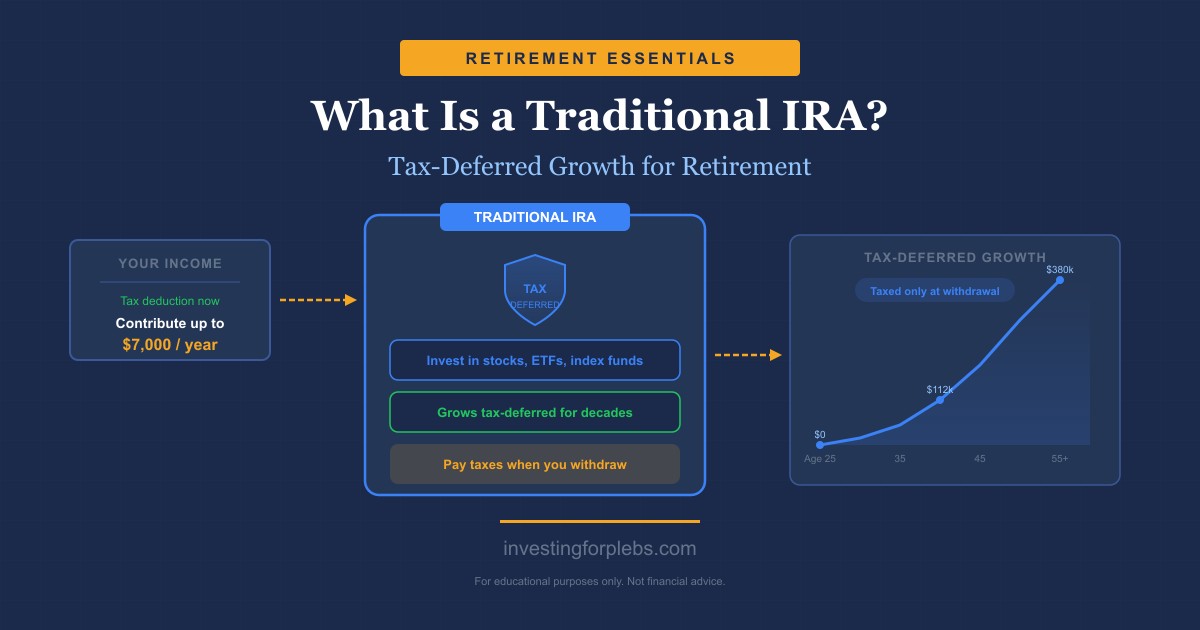
- Roth IRA: Tax-advantaged retirement account. Contributions are after-tax, but growth and withdrawals in retirement are tax-free. Contribution limit is $7,000/year (2025; check IRS.gov for the current year’s limit). If you have earned income and aren’t over the income threshold, this is one of the most powerful tools available to you.
Here’s the general process:
- Choose a brokerage. Look for zero-commission trading, no account minimums, and a clean interface.
- Complete the application. You’ll need your Social Security Number, employment information, and basic financial details. Most applications take 10 to 15 minutes.
- Fund your account. Link a bank account and transfer money in. Some platforms let you start with as little as $1.
- Start investing. Once the transfer clears (usually one to three business days), you can place your first trade.
Want step-by-step guidance? See: How to Open a Brokerage Account
Starting small? See: How to Start Investing With $100
6. Your First Investment: ETFs and Index Funds
Here’s the honest advice most beginners don’t get: don’t start by picking individual stocks.
Picking stocks is harder than it looks. You’re competing against professional investors with teams of analysts, proprietary data, and decades of experience. Even most of them underperform the market over time. For a beginner, stock-picking is a great way to learn expensive lessons fast.
Instead, start with index ETFs or index funds.
What’s an index? A stock market index is a list of stocks that represents a slice of the market. The S&P 500 is the most famous one. It tracks the 500 largest U.S. public companies. When the “market” goes up 10%, that usually means the S&P 500 went up 10%. Learn more: What Is a Stock Market Index?
What’s an ETF? An Exchange-Traded Fund is a basket of stocks (or other assets) that trades on a stock exchange like a single share. A total market ETF might hold 3,000+ stocks at once. You buy one share and you own a tiny slice of all of them. Learn more: What Is an ETF?
What’s an index fund? An index fund works similarly to an ETF but is structured as a mutual fund. You buy it directly from the fund company and it prices once per day. Many index funds are available through retirement accounts. Learn more: What Is an Index Fund?
ETF or index fund? Both are excellent. ETFs are more flexible (you can buy one share at any time). Traditional index funds sometimes require a minimum investment but can be simpler inside retirement accounts. For most beginners in a taxable account, ETFs win on flexibility. Full comparison: ETF vs. Index Fund
The math is compelling: a low-cost index fund tracking the S&P 500 has delivered roughly 10% average annual returns over the long run, before inflation (about 7% after). That’s not guaranteed going forward, but it reflects 90+ years of history. And because you’re diversified across hundreds of companies, one company blowing up doesn’t sink your portfolio.
The key number to watch: expense ratio. This is the annual fee the fund charges, expressed as a percentage. Index ETFs from major providers typically charge 0.03% to 0.20% per year. That means on a $10,000 investment, you’re paying $3 to $20 per year in fees. Compare that to actively managed funds that often charge 0.50% to 1.00%+ and usually don’t outperform anyway.
7. Asset Allocation: How to Split Your Money
Asset allocation is the decision of how much of your portfolio to put in different asset types, primarily stocks versus bonds. It’s the single most important decision you’ll make as an investor.
The right allocation depends on two things: your time horizon and your risk tolerance.
- Long time horizon (10+ years) + high risk tolerance: Mostly stocks. Maybe 80% to 90% stocks, 10% to 20% bonds or other stabilizers.
- Medium time horizon (5 to 10 years) + moderate risk tolerance: Balanced mix. Something like 60% stocks, 40% bonds.
- Short time horizon (less than 5 years) + low risk tolerance: Lean conservative. 40% to 50% stocks, 50% to 60% bonds or cash equivalents.
A common rule of thumb: subtract your age from 110 to get your stock percentage. So a 30-year-old would hold about 80% stocks. It’s a rough guide, not gospel.
What matters is that you pick an allocation you can actually stick with. A 90% stock portfolio is meaningless if you sell everything when the market drops 30%.
Deep dive: What Is Asset Allocation?
8. Diversification: Don’t Put It All in One Basket
Diversification means spreading your investments across different companies, sectors, geographies, and asset types so that a bad spell in one area doesn’t wipe you out.
If you own only one stock and that company goes bankrupt, you lose everything. If you own 500 stocks through an ETF and one goes bankrupt, you barely notice.
Diversification works at multiple levels:
- Across companies: index ETFs do this automatically
- Across sectors: tech, healthcare, energy, consumer goods, financials
- Across geographies: U.S. stocks plus international stocks
- Across asset classes: stocks plus bonds
The simplest diversified portfolio in the world is a three-fund portfolio: a total U.S. stock market ETF, a total international stock market ETF, and a corporate bond ETF. That combination covers almost every base a beginner needs.
Deep dive: How to Diversify Your Portfolio
9. The Power of Dollar-Cost Averaging
Most beginners think they need to figure out the perfect time to invest. They wait for the market to dip, then wait to see if it dips more, then miss the rally, then kick themselves.
Here’s the better approach: don’t try to time the market. Invest consistently on a schedule.
This is called dollar-cost averaging (DCA): investing a fixed amount at regular intervals, say $200 on the first of every month, regardless of what the market is doing.
When prices are high, your $200 buys fewer shares. When prices are low, your $200 buys more shares. Over time, this naturally averages out your purchase price and removes the agonizing “should I buy now?” decision.
DCA is powerful because it removes emotion from investing decisions. You automatically buy more when prices are low. It builds the habit of consistent investing. And it keeps you from waiting forever for the “right time” (there is no right time).
The best setup: automate it. Schedule an automatic transfer from your bank to your brokerage account every payday. Then forget about it.
Want to dig deeper? See: What Is Dollar-Cost Averaging?
10. Growth vs. Income: Two Portfolio Philosophies
As you build your portfolio, you’ll eventually need to decide: do you want it to grow, or do you want it to pay you income along the way?
Growth Investing
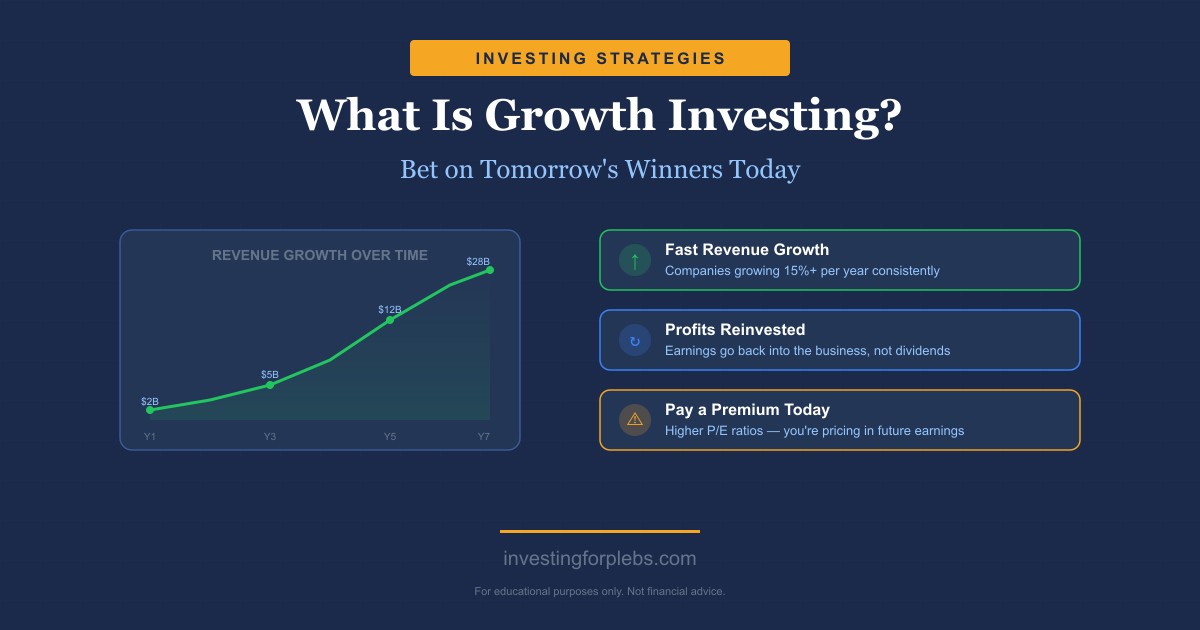
A growth-oriented portfolio prioritizes capital appreciation. You hold growth-focused ETFs, reinvest any dividends, and leave the portfolio mostly alone. This approach works best for long time horizons (retirement, 10+ years away) because you don’t need the money now.
Growth stocks tend to reinvest profits into expansion rather than paying them out. The payoff comes when you eventually sell.
Income Investing
An income-oriented portfolio prioritizes cash flow. You want the portfolio to regularly pay you dividends or interest. Dividend-paying stocks, REITs, and bond ETFs are common income vehicles. This approach works well for investors closer to retirement or those who want passive income without selling shares.
Dividend yield measures how much a company pays in dividends relative to its share price. A 3% yield on a $10,000 portfolio means $300/year in dividend income. Learn more: What Is Dividend Yield?
Which should you choose?
For most beginners, growth first, income later makes more sense. Compound growth is most powerful when you reinvest returns and don’t touch the portfolio for decades. As you approach retirement or a specific income goal, you can shift toward income-producing assets.
Full comparison: Dividend Stocks vs. Growth Stocks
11. Learning to Read the Numbers
Once you’re comfortable with index funds and want to start understanding individual stocks, you’ll need to learn a few key metrics:
Price-to-Earnings Ratio (P/E)
The P/E ratio tells you how much investors are paying per dollar of a company’s earnings. A P/E of 20 means investors are paying $20 for every $1 of annual profit. A high P/E means investors expect strong future growth; a low P/E might signal a bargain or a struggling company.
There’s no universal “good” P/E. It varies widely by industry and market conditions. But knowing a company’s P/E and comparing it to similar companies helps you understand whether it looks expensive or cheap relative to its earnings.
Deep dive: What Is a P/E Ratio?
Earnings Per Share (EPS)
EPS is the company’s total profit divided by the number of shares outstanding. It tells you how profitable the company is on a per-share basis. Growing EPS over time is a healthy sign. Declining EPS deserves scrutiny.
When you hear companies “beat earnings” or “miss earnings,” they’re comparing actual EPS to what analysts predicted. Consistently beating expectations tends to drive stock prices up.
Deep dive: What Does EPS Mean?
Free Cash Flow (FCF)
Free cash flow is the cash a company generates after paying for everything needed to keep the business running and growing. It’s the “real” money, what’s left over that could be used for dividends, buybacks, debt paydown, or expansion.
Some companies report solid earnings but lousy free cash flow. That’s a red flag. Companies with strong, growing free cash flow have flexibility and staying power.
Deep dive: What Is Free Cash Flow?
12. Starter Portfolio Templates
You don’t need a complicated portfolio to build wealth. These three templates cover 95% of what most beginner investors need, using low-cost ETFs you can buy on any major brokerage.
Each uses a three-fund structure: U.S. stocks, international stocks, and bonds. The only thing that changes is the ratio.
Conservative Portfolio (Lower Risk / Shorter Timeline)
Best for: investors within 5 to 10 years of needing the money, or those who know they’d panic during a 30% drawdown.
| Asset Class | Allocation | Example ETF |
|---|---|---|
| U.S. Total Market | 40% | VTI, ITOT, SPTM |
| International Stocks | 20% | VXUS, IXUS |
| Bond ETF (Diversified) | 40% | LQD, VCIT |
Expected behavior: Smaller drops in bad years, slower growth in good years. More stability, less upside.
Balanced Portfolio (Moderate Risk / 10-Year Horizon)
Best for: investors with a 10+ year timeline who want meaningful growth but can stomach some volatility.
| Asset Class | Allocation | Example ETF |
|---|---|---|
| U.S. Total Market | 50% | VTI, ITOT, SPTM |
| International Stocks | 20% | VXUS, IXUS |
| Bond ETF (Diversified) | 30% | LQD, VCIT |
Expected behavior: Steady long-term growth with moderate swings. The classic “sleep at night” portfolio for most investors.
Growth Portfolio (High Risk / Long Horizon)
Best for: investors with 15+ years until they need the money, who can emotionally handle watching their portfolio drop 40% without flinching.
| Asset Class | Allocation | Example ETF |
|---|---|---|
| U.S. Total Market | 60% | VTI, ITOT, SPTM |
| International Stocks | 30% | VXUS, IXUS |
| Bond ETF (Diversified) | 10% | LQD, VCIT |
Expected behavior: Maximum long-term growth potential. Will experience sharp drops in bear markets. Do NOT use this allocation if you have short-term cash needs.
A note on these examples: ETF tickers are provided as examples of the asset class, not as specific recommendations. Always verify expense ratios, tax efficiency, and suitability before investing.
13. Common Mistakes to Avoid
Most investing mistakes aren’t about picking the wrong stocks. They’re about behavior.
Chasing hype. A stock that’s already up 300% in a year is not a “safe” bet just because it’s been going up. By the time something becomes a mainstream news story, the smart money has usually already bought in.
Timing the market. Trying to get out before a crash and back in at the bottom sounds smart. In practice, almost nobody does it successfully. You have to be right twice (when to get out and when to get back in). Miss the 10 best trading days in a given decade, days that often happen during volatile markets, and your long-term returns get cut nearly in half.
Ignoring fees. A 1% annual fee difference doesn’t sound like much. Over 30 years, on a $100,000 portfolio growing at 8%, the difference between a 0.05% expense ratio and a 1% expense ratio is roughly $200,000. Fees compound just like returns do, only they compound against you.
Panic selling. Markets fall. Sometimes dramatically. Every single crash in history has eventually recovered and gone on to new highs. Investors who sold at the bottom locked in their losses permanently. Investors who stayed invested recovered and kept growing.
Overcomplicating it. A three-fund portfolio of index ETFs beats most sophisticated strategies. Don’t add complexity for its own sake.
Using margin. Margin trading means borrowing money from your broker to invest. It amplifies gains, but it amplifies losses too, and you pay interest either way. Beginner investors should stay far away. Learn more: What Is Margin Trading?
Waiting until you have “enough” to start. The best time to start was yesterday. The second-best time is today. A $50 monthly investment started at 22 beats a $500 monthly investment started at 40, because of compound interest. Start small, start now.
14. Your First 30-Day Action Plan
Week 1: Get your foundation right
– Confirm you have an emergency fund (three to six months of expenses)
– Write down your investing goals and timeline
– Assess your risk tolerance honestly
Week 2: Open an account
– Open a brokerage account or Roth IRA. See our step-by-step guide.
– Fund it with whatever you can. Even $50 or $100 builds the habit. See how to start investing with $100.
Week 3: Make your first investment
– Pick a portfolio template from above that matches your risk tolerance
– Buy your first low-cost ETFs in those proportions
– Don’t overthink it. Your first portfolio doesn’t need to be perfect. It needs to exist.
Week 4: Set it on autopilot
– Set up automatic monthly contributions from your bank account
– Schedule a yearly reminder to rebalance if allocations drift significantly
– Keep learning
Once you’ve got the basics down, explore deeper topics. Curious about evaluating individual stocks? Start with our stock analysis guide for beginners. Want to understand blue-chip companies? Read what are blue chip stocks?.
Every Saturday, we publish Stonk Saturday, a deep dive into a single publicly traded company, written in plain English. It’s a great way to see how real stock analysis works without drowning in jargon.
The most important thing you can do right now isn’t finding the perfect stock or timing the market perfectly. It’s starting. Open the account. Make the first investment. The rest follows from there.
This content is for educational purposes only and does not constitute financial advice. investingforplebs.com is not a registered investment advisor. Please consult a qualified financial professional before making investment decisions.
Ready to go deeper? Get the Sunday Pleb every week — free market insights in plain English. Subscribe →


Leave a Reply