

In today’s complex market landscape, the search for outperformance often leads investors toward “factor investing” — an approach focusing on specific attributes (or “factors”) like Growth, Value, and Momentum.
Much like our exploration of commodity ETFs highlighted unique ways to diversify, factor-based ETFs offer another powerful method to tailor your portfolio to personal objectives and market conditions.
In this post, we’ll demystify the concepts behind Growth, Value, and Momentum ETFs, provide examples of popular funds, and discuss how each might fit into a well-rounded investment strategy.
“The key to investing is not assessing how much an industry is going to affect society, or how much it will grow, but rather determining the competitive advantage of any given company and, above all, the durability of that advantage.”
– Warren Buffett
Why use Factor Investing?
Traditional indexes (like the S&P 500) weigh companies based on market capitalization, but factor investing seeks to capture specific drivers of returns. Instead of buying every stock in a particular index, factor ETFs screen for attributes they believe will outperform over time. Three of the most popular and researched factors are:
- Growth – Companies expected to expand earnings or revenue faster than the broader market.
- Value – Companies trading at discounts relative to fundamentals (e.g., price-to-earnings or price-to-book ratios).
- Momentum – Stocks that have shown strong recent performance and are expected to keep outperforming in the near term.
Here’s a comparison of the S&P 500, S&P 500 Growth, and S&P 500 Value ETFs since January 1st, 2000.

As you’ll see, there is a season for each type of investment. For nearly 17 years after the dot-com bubble, Value outperformed. This trend has only reversed in the past decade as mega-cap tech market capitalizations have pushed into the trillions.
Factor investing can offer targeted exposure and potential outperformance, but it also comes with unique risks. Before diving in, assess your tolerance for volatility, investing timeline, and how factor ETFs fit within your larger portfolio strategy.
Large, Medium, and Small Caps
Before we dive into the various Factor ETFs, let’s do a quick refresher on what small, medium, and large cap companies are as:
- Small-Cap: Typically under 2-3 billion USD in market capitalization, these companies are often newer or niche. They can offer higher growth potential but also come with increased volatility. Examples include Crocs (footwear) or Planet Fitness (fitness centers).
- Mid-Cap: Usually in the 3-10 (sometimes up to 20) billion USD range, mid-cap companies strike a balance between growth opportunity and stability. Recognizable names might include Dick’s Sporting Goods (retail) or American Eagle Outfitters (apparel).
- Large-Cap: With valuations exceeding 10-20 billion USD—and often stretching into the hundreds of billions—these are well-established market leaders. Think Apple, Microsoft, or Coca-Cola.
This blog post will provide examples of Factor ETFs for small, medium, and large-cap companies. We have not included any examples of international ETFs. Happy Reading!
Growth ETFs
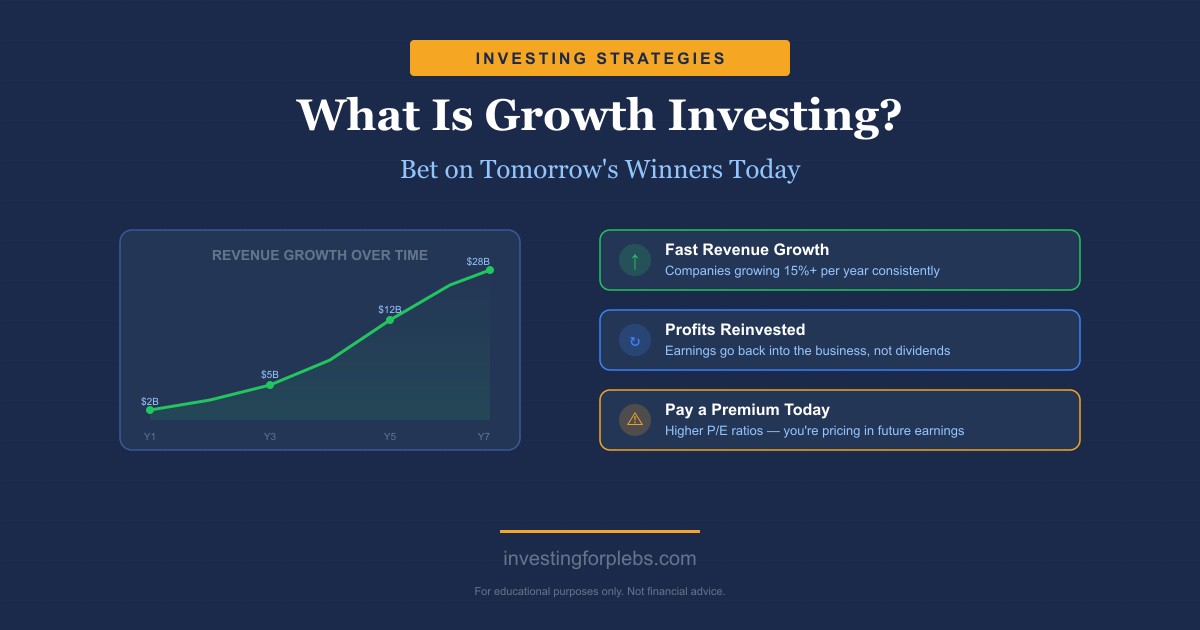
Growth investing focuses on companies with above-average revenue or earnings growth. Growth stocks often reinvest profits to expand their operations rather than paying dividends, betting on future gains in share price.
Key Characteristics
- High Earnings Growth Potential: These companies often have strong sales growth or innovative product pipelines.
- Lower Dividend Yields: They tend to reinvest earnings into expansion, so don’t expect large dividends.
- Higher Valuations: Growth stocks often trade at higher price-to-earnings (P/E) ratios due to optimism about future profits.
“In the short run, the market is a voting machine, but in the long run, it is a weighing machine.”
– Benjamin Graham
While this Graham quote was originally a note of caution, Growth investors interpret it to mean that superior fundamentals eventually shine through in the stock price.
Popular Growth ETFs
| Name | Ticker | Expense Ratio | AUM |
| Vanguard Growth ETF (Blend) | VUG | 0.04% | $163B |
| iShares S&P 500 Growth ETF (Large Cap) | IVW | 0.18% | $59.47B |
| SPDR Portfolio S&P 500 Growth ETF (Large Cap) | SPYG | 0.04% | $36.38B |
| Vanguard S&P 500 Growth ETF (Large Cap) | VOOG | 0.07% | $16.59B |
| Vanguard Mid-Cap Growth ETF | VOT | 0.07% | $16.55B |
| iShares S&P Mid-Cap 400 Growth ETF | IJK | 0.17% | $9.61B |
| Vanguard Small Cap Growth ETF | VBK | 0.07% | $20.33B |
| iShares Russell 2000 Growth ETF (Small Cap) | IWO | 0.24% | $16.66B |
| SPDR S&P 600 Small Cap Growth ETF | SLYG | 0.15% | $3.70B |
*Expense Ratios and AUM are approximate and subject to change.
Why Invest in Growth?
- Potential for significant share price appreciation.
- Exposure to innovative and disruptive companies (e.g., tech or biotech firms).
- Strategy can outperform in bullish, low-interest-rate environments.
Potential Downsides
- Higher valuations can lead to steeper drawdowns if growth expectations fail to materialize.
- Lower dividend payouts mean returns hinge more on price appreciation.
Here’s the performance of a few sample growth ETFs compared to the S&P 500 over the past 20 years. Large-cap growth has vastly outperformed.

Checkout other Value ETFs from other brokers here at VettaFi’s ETF Database.
Value ETFs
Value investing centers on finding companies whose stocks trade below their intrinsic value, often measured by metrics like P/E ratio, price-to-book (P/B), or discounted cash flow. Legendary investors like Warren Buffett and Benjamin Graham have long championed this style.
Key Characteristics
- Undervalued Stocks: Based on fundamental metrics, the stocks are relatively cheap compared to peers.
- Potential for Mean Reversion: Value investors bank on the market, eventually recognizing a company’s true worth.
- Often Mature, Established Companies: Value stocks are frequently from industries that are out of favor or overlooked.
“It’s far better to buy a wonderful company at a fair price than a fair company at a wonderful price.”
– Warren Buffett
Popular Value ETFs
| Name | Ticker | Expense Ratio | AUM |
| Vanguard Value ETF (Blend) | VTV | 0.04% | $137B |
| iShares S&P 500 Value ETF (Large Cap) | IVE | 0.18% | $36.1B |
| SPDR Portfolio S&P 500 Value ETF (Large Cap) | SPYV | 0.04% | $25.82B |
| Vanguard S&P 500 Value ETF (Large Cap) | VOOV | 0.07% | $5.43B |
| iShares Core S&P Mid-Cap ETF | IJH | 0.05% | $97.85B |
| Vanguard Mid-Cap Value ETF | VOE | 0.07% | $18B |
| iShares S&P Mid-Cap 400 Value ETF | IJJ | 0.17% | $9.61B |
| Vanguard Small Cap Value ETF | VBR | 0.07% | $31.86B |
| iShares Russell 2000 Value ETF (Small Cap) | IWN | 0.24% | $12.36B |
| SPDR S&P 600 Small Cap Value ETF | SLYV | 0.15% | $4.24B |
*Expense Ratios and AUM are approximate and subject to change.
Why Invest in Value?
- Typically, they have lower volatility and higher dividend yields than growth stocks.
- Historically, value investing has shown long-term resilience, though performance can be cyclical with economic trends.
Potential Downsides
- “Value traps” occur when a stock is cheap for a good reason (e.g., declining business prospects, new disruptors in the market, etc.).
- Value may underperform for extended periods, think decades, particularly when Growth and tech sectors boom.
Here’s the performance of a few value ETFs relative to the S&P 500 over the past 20 years. The S&P 500 has outperformed all cap-weighted value during the tech expansion of the past decade.

Checkout other Value ETFs from other brokers here at VettaFi’s ETF Database.
Momentum ETFs
Momentum investing harnesses the idea that “winners keep winning.” It targets stocks with recent strong performance, assuming these trends will continue over a short to medium timeframe.
Key Characteristics
- Trend-Focused: Momentum strategies look for upward price patterns in stocks, sectors, or markets.
- High Turnover: Since the focus is on recent outperformance, these ETFs often rebalance more frequently and as a result usually have higher fees.
- Sector Concentration: Momentum ETFs can be heavily weighted in a few sectors if those sectors outperform.
“The trend is your friend—until it ends.” – Market Proverb
Popular Momentum ETFs
| Name | Ticker | Expense Ratio | AUM |
| iShares MSCI USA Momentum Factor ETF (Blend) | MTUM | 0.15% | $16.40B |
| Invesco S&P 500 Momentum ETF (Large Cap) | SPMO | 0.13% | $5.71B |
| Invesco S&P MidCap Momentum ETF | XMMO | 0.34% | $3.98B |
| Invesco S&P SmallCap Momentum ETF | XSMO | 0.39% | $1.52B |
*Expense Ratios and AUM are approximate and subject to change.
Why Invest in Momentum?
- Potential to capture rapid share price appreciations.
- Historically, Momentum has shown periods of strong outperformance, especially in bull markets.
Potential Downsides
- High turnover often leads to increased transaction costs and tax implications.
- Sharp reversals can happen quickly if market sentiment changes.
Here’s the performance of the momentum ETFs in our table above relative to the S&P 500 over the past 20 years. Interestingly, MidCap momentum has outperformed nearly by a factor of two.

Checkout other high-momentum ETFs from other brokers here at VettaFi’s ETF Database.
Adding Factor ETFs into your Portfolio
Many investors balance their portfolios by combining Growth, Value, and Momentum strategies. This can smooth out the inherent cyclicality of each factor:
- Value and Growth can counterbalance each other, with Value offering a steadier, dividend-friendly approach and Growth aiming for higher capital appreciation.
- Momentum can complement both by capitalizing on short-term trends—though it also introduces more frequent trading.
Multi-Factor ETFs A growing niche is multi-factor ETFs incorporating several factors (e.g., Growth + Value + Momentum + quality + size). These aim for a diversified factor approach within one fund.
Market Conditions and Performance
Each factor can shine or struggle under different market conditions:
- Bull Markets: Growth and Momentum tend to do well.
- Early Recoveries: Value often leads as battered stocks rebound.
- Volatile or Neutral Markets: Momentum may undergo swift reversals, while Growth may plateau if an earnings slowdown or growth scare rears its head.
Key Considerations
- Expense Ratios & Fees: Factor ETFs vary in cost. Higher turnover in Momentum ETFs might result in higher expense ratios.
- Liquidity & Trading Volume: Ensure the fund has sufficient trading volume to facilitate easy entry and exit.
- Sector Concentration: Growth and Momentum ETFs can cluster in tech or other hot industries, increasing risk exposure.
- Investment Timeline & Risk Tolerance: Factor strategies can underperform for lengthy periods. Be prepared for potential drawdowns.
“Discipline and patience are the pillars of successful investing—regardless of strategy.”
– A Fellow Pleb
Closing
Growth, Value, and Momentum ETFs provide a compelling gateway into factor investing, allowing you to target specific market characteristics in a diversified, cost-effective manner. Whether you’re drawn to the high-upside potential of Growth, the bargain-hunting allure of Value, or the trend-chasing excitement of Momentum, factor-based ETFs offer a myriad of ways to customize your portfolio.
Yet, as with all investments, understanding the nuances is critical. Consider how each factor aligns with your financial goals and risk tolerance, and remember that even the most robust strategy can take time to bear fruit. By combining these factors—or focusing on the one that resonates with your outlook—you can craft a portfolio that remains adaptive, resilient, and positioned for opportunity.
Please like and subscribe if you found this blog post informative. We appreciate your time and look forward to continuing our investing journey together.

Leave a Reply