

TL;DR: Dollar cost averaging (DCA) means investing a fixed dollar amount on a fixed schedule (every week, every month, every paycheck) regardless of what the market is doing. You don’t try to time the market. You just show up consistently. It’s one of the most effective, least stressful strategies for everyday investors.
Table of Contents
- What is dollar cost averaging?
- How it works: a simple example
- Why it works psychologically
- When DCA works best (and when it doesn’t)
- DCA vs. lump sum investing
- Is DCA a good strategy?
- How to start DCA-ing today
- The honest answer to “but what if prices just keep going up?”
- Key takeaway
What is dollar cost averaging?
Dollar cost averaging is exactly what it sounds like: you invest a fixed dollar amount on a regular schedule, and the cost you pay per share averages out over time.
No checking the news before you buy. No waiting for a dip. No gut-wrenching decisions about whether now is the right moment. You just invest $X on the same day every month (or week, or paycheck period) and let the math work.
When prices are low, your fixed amount buys more shares. When prices are high, it buys fewer. Over time, you end up with an average cost that smooths out the peaks and valleys.
This is the strategy behind most 401(k) contributions. If you’ve ever had money automatically deducted from your paycheck into a retirement account, you’ve already been dollar cost averaging without knowing it.
How it works: a simple example
Let’s say you invest $100/month in an S&P 500 index fund for 6 months. The fund price fluctuates each month:
| Month | Price Per Share | Amount Invested | Shares Purchased |
|---|---|---|---|
| Jan | $50.00 | $100 | 2.00 |
| Feb | $40.00 | $100 | 2.50 |
| Mar | $35.00 | $100 | 2.86 |
| Apr | $45.00 | $100 | 2.22 |
| May | $55.00 | $100 | 1.82 |
| Jun | $60.00 | $100 | 1.67 |
| Total | — | $600 | 13.07 shares |
Average price you paid per share: $600 ÷ 13.07 = $45.91
Average market price over those 6 months: ($50 + $40 + $35 + $45 + $55 + $60) ÷ 6 = $47.50
You paid less per share than the simple average price, because DCA automatically had you buying more shares when prices were lower.
Now those 13.07 shares are worth $60 each = $784.20 on a $600 investment. A 31% gain.
The key insight: you didn’t need to know that the bottom was in March. The strategy bought more at the low for you.
Why it works psychologically
The real enemy of investing returns isn’t bad stocks — it’s bad timing driven by emotion.
People buy more when markets are soaring (FOMO). They sell when markets crash (panic). This consistently leads to buying high and selling low: the exact opposite of what you want.
Dollar cost averaging removes those emotional decision points. There’s no “should I buy now or wait for a dip?” Every month, same day, same amount, done. You can’t panic-sell what you haven’t bought. You can’t FOMO-buy more than your scheduled amount.
The boring consistency is the entire point. Markets go up and down in ways no one reliably predicts — not analysts, not fund managers, not the guys on financial Twitter. DCA doesn’t try to beat the market’s timing. It just makes sure you’re always participating.
When DCA works best (and when it doesn’t)
Where DCA shines:
- Regular income investors: If you’re investing from a paycheck, DCA is a natural fit. Set it up once, automate it, forget about it.
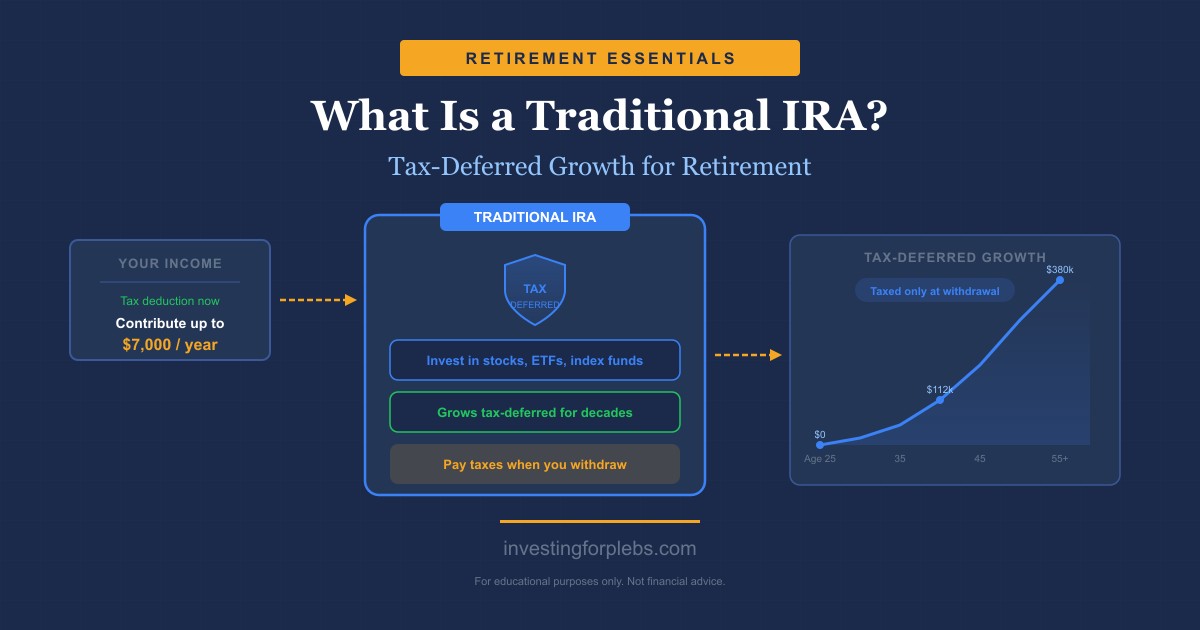
- 401(k) and IRAs: Most retirement contributions are already structured as DCA by default. This is a feature, not a bug.
- Volatile assets: The more an asset swings in price, the more DCA’s averaging effect helps. DCA smooths out volatility during a bear market and is particularly well-suited to broad index funds and individual stocks with long-term upside.
- New investors: If you’re just starting out and terrified of “buying at the top,” DCA lets you start immediately rather than waiting for a perfect entry that may never come.
Where DCA is less useful:
- Lump sum situations: If you inherit $50,000 or receive a bonus, research consistently shows that investing the full lump sum immediately outperforms slowly DCA-ing it in over time, roughly 2 out of 3 times, over 12-month windows. Markets go up more often than they go down. That said, “lump sum immediately” is often emotionally impossible for real people. If spreading out a lump sum over 3–6 months lets you actually do it rather than freeze, that’s worth something.
- Short time horizons: If you need the money in 2 years, you shouldn’t be in volatile assets in the first place. DCA doesn’t solve asset allocation.
DCA vs. lump sum investing
If you have a large sum available right now (an inheritance, a bonus, a windfall), should you invest it all at once, or spread it out over time with DCA?
The research has a clear answer: lump sum investing beats DCA about two-thirds of the time over 12-month periods. Markets go up more than they go down, so getting fully invested earlier tends to produce better results. Vanguard studied this across U.S., U.K., and Australian markets and found lump sum outperforms DCA roughly 67% of the time.
But that’s the math. Real investing involves real humans.
For most people, dumping a large sum into the market in one shot is emotionally very difficult, especially when the market is near all-time highs or when volatility is elevated. If the market drops 15% the week after you go all in, you might panic and sell at exactly the wrong moment. DCA gives you something to do: invest steadily, ignore the noise, keep going regardless.
The practical answer: if you can genuinely invest a lump sum without emotion getting in the way, do it. If spreading the investment over 3–6 months is what it takes to actually follow through without panicking, that’s worth more than the theoretical extra return from timing it perfectly.
Is DCA a good strategy?
Yes — for most everyday investors, DCA is the right approach.
Here’s why it works in the real world:
Almost everyone earns money on a schedule (paycheck every two weeks, monthly salary). That makes DCA the natural fit. You’re already dollar cost averaging if you contribute to a 401(k) automatically, and most Americans with retirement accounts are already doing this, often without realizing it.
DCA also solves the most common investing failure mode: inaction. People delay investing because they’re waiting for the “right moment” that never arrives. DCA removes the decision entirely. The schedule is the strategy.
Is it perfect? No. Lump sum beats it on paper. It doesn’t protect you from sustained crashes (nothing does). And if you’re DCA-ing into a bad investment, you’re just buying more of something that’s declining.
But for a diversified, long-term investment in something like an S&P 500 index fund, DCA is an excellent strategy. It’s automated, consistent, emotionally manageable, and backed by decades of real-world evidence in the form of America’s 401(k) system.
How to start DCA-ing today
Starting is simpler than most people think.
Step 1: Pick an amount you can invest on autopilot.
This doesn’t need to be large. $50/month is fine. The point is consistency, not size. Choose a number that fits your budget and that you won’t miss.
Step 2: Choose what you’re buying.
For most investors, a broad ETF or index fund is the right starting point. Low fees, instant diversification, no stock-picking required.
Step 3: Set up automatic contributions.
Every major brokerage (Fidelity, Vanguard, Schwab, Robinhood) lets you set up automatic recurring investments. Do this once and let it run. Remove the weekly decision of “should I invest this week?”
Step 4: Leave it alone.
This is the hardest part. When the market drops, don’t stop. When the market surges, don’t move the money somewhere “better.” The whole point of DCA is that you keep investing regardless of conditions. Time and consistency do the work.
The honest answer to “but what if prices just keep going up?”
This is the most common objection: “What if I keep buying and the price never dips? Won’t I just end up paying more and more?”
Yes — and that’s fine. If prices keep going up, your earlier purchases are already profitable. You’re buying shares at progressively higher prices, but your older shares are worth more. The whole point of investing is that markets trend upward over long time horizons.
The alternative (waiting for a dip or trying to time entries based on valuation metrics) has historically been a losing strategy. Markets spend more time going up than going down. The “perfect entry” often never arrives, or arrives during a crash when you’re too scared to buy anyway.
The old saying is annoyingly true: “Time in the market beats timing the market.” DCA is the practical tool that puts that principle into action, and when you pair it with compound interest, the long game gets very powerful.
Key takeaway
Dollar cost averaging means investing a fixed amount on a fixed schedule, no matter what the market is doing. It automatically buys more shares when prices are low and fewer when they’re high, smoothing out your average cost over time. More importantly, it removes the emotional decision-making that leads most people to buy high and sell low. Set it up, automate it, and let time do the work.
This content is for educational purposes only and does not constitute financial advice. investingforplebs.com is not a registered investment advisor. Please consult a qualified financial professional before making investment decisions.
Enjoyed this? Get the Sunday Pleb every week: free market insights in plain English. Subscribe →
Sources: Vanguard: Dollar-cost averaging just means taking risk later | Investopedia: Dollar-Cost Averaging
Leave a Reply