
TL;DR:
– When the Fed raises interest rates, the future earnings of every company are worth less today, even if the business is doing great
– Growth stocks (tech, biotech) get hit hardest; value stocks and financials tend to be more resilient
– For long-term investors: rate hike cycles are painful short-term but historically haven’t derailed well-diversified portfolios
Table of Contents
- First: What Is the Fed, and What Are “Rates”?
- The Actual Mechanism: Why Rate Hikes Push Down Stock Prices
- Which Stocks Get Hit Hardest, and Why
- The 2022 Case Study: What Actually Happened
- What About Bonds? The Rate-Stock-Bond Triangle
- What Should Long-Term Investors Do During a Rate Hike Cycle?
Your portfolio drops. The company you own is doing great — profits are up, they just beat earnings. But the stock is down 20%. What’s happening?
The answer almost always traces back to the same place: the Federal Reserve just raised interest rates. And the reason why that tanks stock prices, even for perfectly healthy companies, is something most financial news never explains clearly. Let’s fix that.
First: What Is the Fed, and What Are “Rates”?
The Federal Reserve (the Fed) is the U.S. central bank. One of its main jobs is setting the federal funds rate: the baseline interest rate at which banks borrow money from each other overnight.
That number might sound arcane, but it sets the floor for borrowing costs across the entire economy. When the Fed raises it, mortgages get more expensive. Business loans get more expensive. Credit card rates go up. The ripple spreads everywhere.
Why would the Fed deliberately make borrowing more painful? To cool down inflation. When prices are rising too fast, the Fed raises rates to slow spending. Higher borrowing costs make people and businesses think twice before taking on debt and making purchases. Less spending, less pressure on prices.
That’s the intended effect. The unintended side effect? Your portfolio usually takes a hit.
The Actual Mechanism: Why Rate Hikes Push Down Stock Prices
This is the part most financial news skips right past. You’ve probably heard that “higher rates are bad for stocks.” But why? The actual mechanism is almost never explained clearly. Here it is.
The “future earnings” problem
Think of every publicly traded company as a machine that generates money over time. Apple will earn profits this year, but also next year, and the year after, and for years to come. When you buy a share of Apple, you’re essentially buying a slice of all those future earnings.
Now here’s the key question: how much is a future dollar worth to you today?
Imagine someone promises to pay you $1,000 ten years from now. How much would you pay for that promise today?
If interest rates are low (say, 1%), you’d pay a lot for it, maybe $900. Because money in a savings account barely grows, future money is almost as valuable as present money.
If interest rates are high (say, 7%), you’d pay much less, maybe $500. Because you could put $500 in a bond today, earn 7% for a decade, and end up with more than $1,000 without anyone needing to promise you anything.
Now scale that up. Every publicly traded company is a collection of future earnings-promises. When interest rates rise, every one of those future promises becomes worth less in today’s dollars. That’s what a Fed rate hike does to the stock market: it reprices every future dollar of corporate profit downward.
No crisis. No fraud. No recession. Just math.
Why this is different from “the economy is doing badly”
Here’s what trips up a lot of investors: a company can be growing profits, hiring, and executing perfectly — and still see its stock price fall during a rate hike cycle.
That’s the part that feels unfair. “The company is doing great. Why is the stock down?”
Because the stock isn’t just a reflection of how the business is doing today. It’s a reflection of what all those future earnings are worth at the current interest rate. When rates rise, the valuation falls. Not because the business is worse, but because the math changed.
This is closely related to why P/E ratios compress during rate hike cycles: investors simply won’t pay as high a multiple for earnings when they can earn a real return elsewhere.
Which Stocks Get Hit Hardest, and Why
Not all stocks are equally vulnerable to rate hikes. The logic follows directly from the mechanism above: the further away a company’s earnings are, the harder it gets hit.
| Stock Type | Rate Hike Impact | Why |
|---|---|---|
| Growth/Tech (high P/E) | ❌ Hardest hit | Future earnings discounted heavily; valuations compress |
| Highly leveraged companies | ❌ Hard hit | Borrowing costs rise; margins get squeezed |
| Speculative/money-losing | ❌ Hardest hit | No near-term earnings to anchor valuation |
| Financials (banks) | ✅ Can benefit | Higher rates widen net interest margins |
| Value stocks (low P/E, near-term earnings) | ✅ More resilient | Less dependent on far-future earnings; priced on current cash flows |
| Dividend stocks | ⚠️ Mixed | Compete with bonds for income-seekers; may lag bonds short-term |
Growth stocks like high-flying tech companies are particularly vulnerable because their value is almost entirely built on future earnings: earnings they haven’t generated yet. A company trading at 50x earnings that suddenly gets repriced to 30x earnings just lost 40% of its stock price, even if the underlying business didn’t skip a beat.
Highly indebted companies face a direct hit: they have to roll over debt at higher rates, meaning more of every dollar of revenue goes to interest payments rather than profit. That shrinks free cash flow directly.
Banks are the unusual beneficiary. They borrow short-term and lend long-term, and when rates rise, they can charge more on new loans than they pay depositors, widening their profit margin on every dollar they lend.
The 2022 Case Study: What Actually Happened
This isn’t just theory. We got a textbook example in 2022.
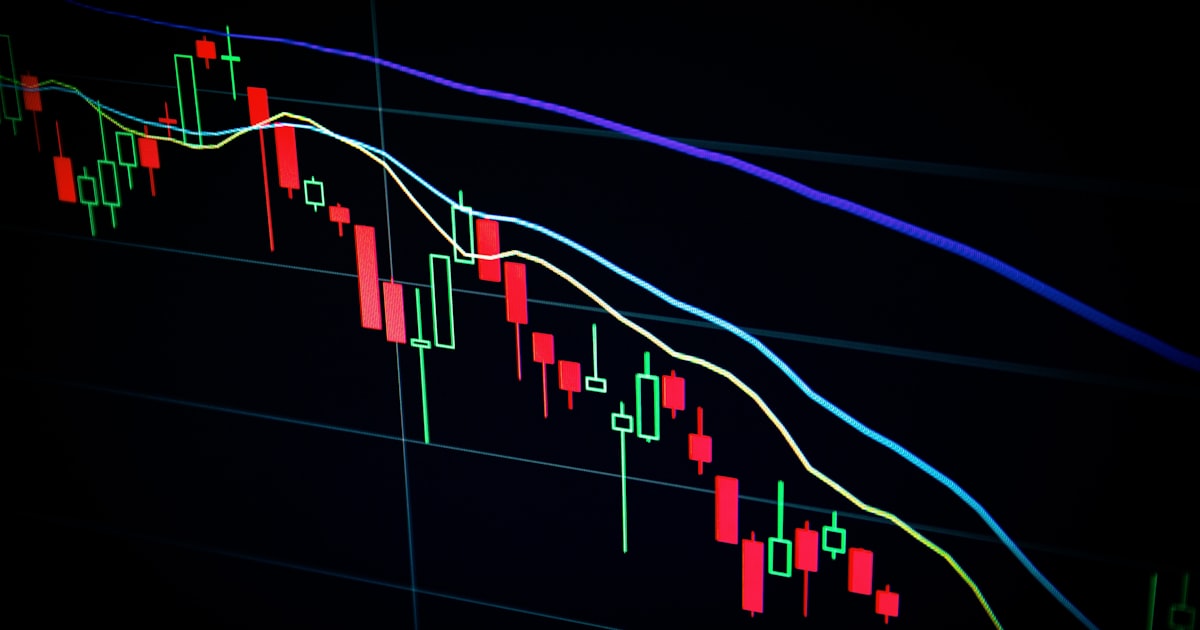
In early 2022, the Fed funds rate was near zero, where it had sat for most of the pandemic. Then inflation hit 40-year highs, and the Fed responded aggressively: by December 2022, rates had climbed from near 0% to 4.5% — the fastest hiking cycle in four decades.
The results matched the theory almost exactly:
- Nasdaq: fell roughly 33% for the year
- S&P 500: fell roughly 19%
- Growth and tech stocks: many fell 50–70% (Amazon, Meta, Netflix, and others)
- Energy stocks (XLE): gained roughly 65%
- Banks: held up relatively well compared to the broader market
2022 was painful because the stock market and bond market fell at the same time, which almost never happens. (Bond prices move inversely to rates: when rates rise, existing bonds lose value because new bonds pay more. So a traditional 60/40 portfolio of stocks and bonds offered no shelter in 2022. More on stocks vs. bonds.)
Then came the reveal: by late 2023, when it became clear that the rate hike cycle had peaked, growth stocks came roaring back. Nvidia more than tripled. The companies hadn’t changed. The math did.
What About Bonds? The Rate-Stock-Bond Triangle
Rate hikes ripple through bonds in a parallel way. When rates rise, newly issued bonds pay higher interest. That makes existing bonds, paying the old, lower rate, less attractive. So existing bond prices fall.
This is why 2022 was so unusual and so painful: both stocks and bonds fell simultaneously. A portfolio designed to balance risk through diversification suddenly had nowhere to hide.
For most investors, understanding that bonds behave inversely to rates is enough. The key insight: when rates rise fast and from a very low base, short-term pain is broad.
What Should Long-Term Investors Do During a Rate Hike Cycle?
The short answer: mostly, stay the course.
Every rate hike cycle in modern U.S. history has eventually ended. In each one, stocks recovered, and in most cases, the recovery came well before the economy fully healed. Patient investors who held through 2022 and into 2023 saw those losses reverse.
A few things worth considering:
Dollar-cost averaging works especially well in downturns. If you’re putting money in regularly (monthly into your 401(k), for example), a rate-driven selloff means you’re buying shares at lower prices. Dollar-cost averaging turns short-term volatility into a long-run advantage.
Some investors tilt toward value and financials. Not wholesale repositioning, but a modest tilt toward sectors that hold up better during rate hike cycles (banks, energy, value stocks) is a common strategy. It’s not right for everyone, and it introduces its own risks.
What not to do: sell growth stocks at the bottom of a rate hike cycle. The temptation is real — watching a 50% drop is brutal. But selling locks in the loss and means you won’t own those stocks when rates stabilize and valuations recover.
The 2022-to-2023 cycle is instructive: the investors who did best were often the ones who did the least.
This content is for educational purposes only and does not constitute financial advice. investingforplebs.com is not a registered investment advisor. Please consult a qualified financial professional before making investment decisions.
Enjoyed this? Get the Sunday Pleb every week: free market insights in plain English. Subscribe →
Leave a Reply