
TL;DR
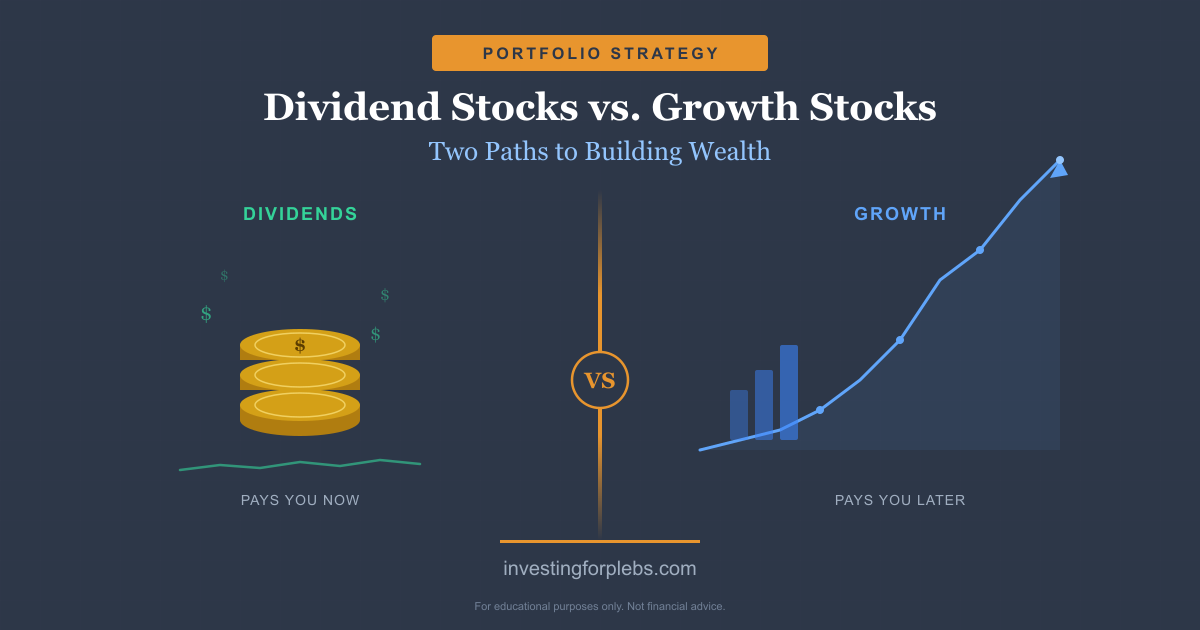
– Dividend stocks pay you cash income regularly; growth stocks aim to grow in price over time.
– Neither is universally better — the right choice depends on your goals, timeline, and risk tolerance.
– Most beginners are better off owning both through a diversified portfolio than forcing an either/or choice.
If you search “should I buy dividend stocks or growth stocks,” you’ll find 50 articles that describe both. Very few actually tell you which one makes sense for you. This one will.
The honest answer is more nuanced than most guides let on, and that nuance matters. Getting it wrong can cost you real money. Let’s break it down.
Quick Comparison: Dividend vs. Growth Stocks
| Dividend Stocks | Growth Stocks | |
|---|---|---|
| How you earn | Regular cash payouts + potential price gain | Price appreciation (usually no dividend) |
| Risk level | Generally lower volatility | Generally higher volatility |
| Best for | Income, stability, shorter time horizons | Long-term wealth building, longer time horizons |
| Example companies | Coca-Cola, Johnson & Johnson, Procter & Gamble | Amazon, Nvidia, Salesforce |
| What the company does with profits | Pays cash out to shareholders | Reinvests to fund more growth |
What Are Dividend Stocks?
A dividend stock is a share of a company that regularly distributes a portion of its profits directly to shareholders. Most pay quarterly. You own shares, they send you cash.
Why can some companies afford to do this? Because they’re mature businesses generating more cash than they need to reinvest. Think Coca-Cola: they’ve been selling the same beverages for decades, and their operations generate reliable cash flow year after year. They don’t need to plow every dollar back into the business to stay competitive. So they share it. (See: what is free cash flow, the metric that tells you whether a company can actually support its dividend.)
The amount you earn relative to what you paid is called the dividend yield: if a stock pays $2 per year in dividends and trades at $40, the yield is 5%. Simple math, but the implications are important. More on that shortly.
Historically, dividends have accounted for roughly 40% of the S&P 500’s total returns. That’s not a minor footnote; it’s a big reason why reinvesting dividends over time is one of the most reliable wealth-building strategies available to regular investors.
Classic examples: Coca-Cola (KO), Johnson & Johnson (JNJ), Procter & Gamble (PG), Kinder Morgan (KMI).
What Are Growth Stocks?
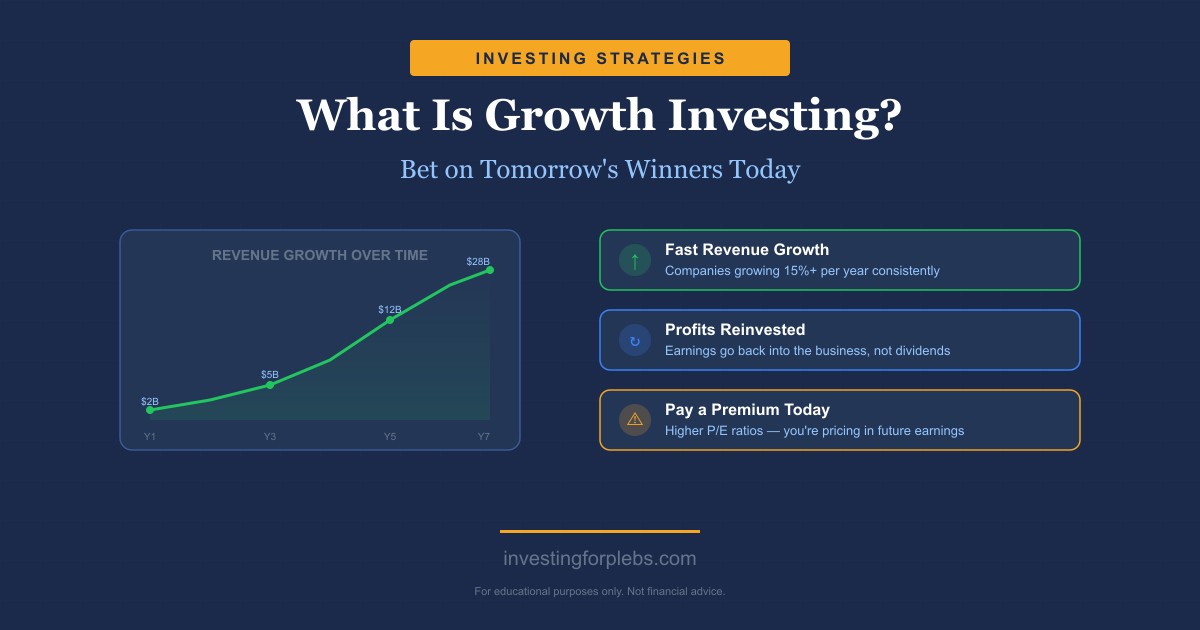
A growth stock is a share of a company expected to grow its revenue and earnings significantly faster than average. Instead of paying dividends, it reinvests every available dollar back into the business to accelerate that growth.
Amazon in its early years is the textbook example. For years, it barely turned a profit because it was reinvesting everything into warehouses, logistics, and new product lines. Investors who held on were betting on future earnings, not current payouts.
Today, Nvidia fits this mold. The company reinvests heavily into chips, AI infrastructure, and R&D. You’re not getting quarterly checks. You’re betting the stock is worth a lot more in five or ten years than it is now.
Because the investment case rests on future earnings, growth stocks often trade at high price-to-earnings (P/E) ratios. Investors are essentially saying: “I’ll pay a premium today because I believe the earnings will be much higher tomorrow.” That’s fine when the growth materializes. When it doesn’t, the correction can be brutal.
Growth stocks also tend to be measured by earnings per share (EPS) growth rate: how fast a company’s profits per share are expanding. A high and accelerating EPS growth rate is the signal growth investors are hunting for.
Classic examples: Amazon (AMZN), Nvidia (NVDA), Salesforce (CRM).
The “Total Return” Concept — Why the Comparison Isn’t as Simple as It Looks
Here’s the insight that most articles completely miss.
Beginners often think of dividend stocks as the “income” option and growth stocks as the “appreciation” option. That framing is too simple, and it leads people to make bad decisions.
Total return = price appreciation + dividends received. That’s the only number that actually matters.
Consider two stocks:
– Stock A pays a 5% dividend yield. But the stock itself has fallen 8% this year. Your total return: -3%.
– Stock B pays no dividend at all. But it’s up 11% in price. Your total return: +11%.
Which one made you money? Not the one with the bigger yield.
This works the other way too: a stock paying a consistent 3% dividend while growing 9% per year in price is delivering a 12% total return. That’s exceptional. Neither the dividend nor the price appreciation alone tells the full story.
The point isn’t that dividends are bad. Yield is just one part of the equation. Always evaluate total return.
The #1 Beginner Mistake: Chasing Yield
This is the trap that catches more new investors than almost anything else.
You’re scanning stocks and you see one with a 9% dividend yield. That looks incredible compared to the 1.3% on a savings account. You buy it.
Three months later, the company cuts the dividend and the stock drops 30%.
Here’s what happened: dividend yield is calculated as annual dividend divided by stock price. When a stock’s price falls sharply (often because the business is struggling), the yield spikes automatically. A 9% yield is often the market’s way of telling you something is wrong, not its way of offering you a deal.
The signal to watch: Is the company’s free cash flow actually covering its dividend payments? If a company is paying out more than it earns, the dividend is on borrowed time. A payout ratio above 80-90% on weak free cash flow is a yellow flag. A payout ratio above 100% is a red one.
The 9% yield that looks irresistible is sometimes the market warning you to stay away.
The Risk Trade-Off
Dividend Stock Risks
- Price still fluctuates. A dividend doesn’t insulate your portfolio from capital losses. If the stock falls 15% and pays a 3% dividend, you’re still down 12% in total.
- Dividend cuts happen. Companies reduce or eliminate dividends more often than people expect. When they do, the stock price typically falls hard at the same time.
- Slower growth ceiling. Mature dividend payers rarely 5x in value. The trade-off for stability is a lower ceiling on appreciation.
- Interest rate sensitivity. When interest rates rise, dividend stocks often underperform because investors can get yield from other sources without the equity risk. If you want to understand this dynamic, see why Fed rate hikes hurt stocks.
Growth Stock Risks
- High volatility. Growth stocks can fall 30-50%+ during corrections, and they often do. If you’re concentrated in growth, expect turbulent rides.
- No income cushion. In a downturn, there are no dividends to offset the paper losses. You’re holding through the pain with nothing coming in.
- Valuation risk. When a growth stock trades at a high P/E and growth disappoints, the repricing can be severe. Knowing how to tell if a stock is overvalued is especially important in this category.
- Future growth is never guaranteed. Many companies that looked like unstoppable growth stories stumbled badly. The premium you paid for future earnings can evaporate fast if those earnings don’t materialize.
Who Each Strategy Is Right For
This is the question every article avoids answering directly. We’ll answer it.
Dividend Investing May Suit You If…
- You need income from your portfolio now or soon (retirees, people approaching retirement, FIRE seekers)
- You prefer lower volatility and can sleep better knowing cash is coming in regardless of market mood
- Your time horizon is shorter (10 years or less until you start withdrawing)
- You want to reinvest dividends automatically via a DRIP (dividend reinvestment plan) to let compounding do the work
Growth Investing May Suit You If…
- You have 10+ years before you need to access the money
- You can watch your portfolio drop 30-40% in a bad year without panic-selling (be honest here; most people overestimate their tolerance)
- You don’t need current income from your investments
- You’re in an accumulation phase, adding money consistently regardless of market conditions
The Honest Answer for Most Beginners
Most beginners are better served by a diversified mix than by picking a side.
A broad S&P 500 index fund already gives you exposure to both worlds: Apple and Nvidia on the growth side, Coca-Cola and Johnson & Johnson on the dividend side. You don’t have to choose. A broad index ETF is, in many ways, the most rational starting point precisely because it doesn’t force the either/or decision. (For more on this, see ETF vs. index fund.)
Asset allocation matters more than picking a “side.” The percentage of your portfolio in stocks versus other assets, and how those stocks skew between growth and income, should reflect your timeline, income needs, and actual risk tolerance. Not which side won the last decade.
As your portfolio grows and your goals become clearer, you can tilt toward one or the other. But starting with a diversified mix is not a compromise. For most beginners, it’s the right answer.
Blue Chip Stocks: Where They Fit In
One category bridges both worlds: blue chip stocks. These are large, stable, established companies with long track records of consistent earnings.
Many of the most reliable dividend payers are blue chips. That’s not a coincidence: blue chip stocks tend to generate durable free cash flow year after year, which is what makes a dividend sustainable. J&J, Procter & Gamble, and Coca-Cola aren’t exciting growth plays, but they’ve raised their dividends every year for decades. For investors who want stability with income, they’re worth understanding.
The Takeaway
Dividend stocks and growth stocks aren’t competing products. They’re different tools for different jobs.
If you need income today or you’re close to using your portfolio, dividend-paying companies offer something growth stocks don’t: cash in your pocket while you wait. If you have decades and don’t need current income, growth stocks offer compounding potential that dividend payers can rarely match.
For most people just starting out, the answer isn’t one or the other. It’s both, through a diversified portfolio you can hold through the inevitable rough stretches.
The single most important habit, whichever direction you lean: look at total return, not just yield or price. That’s the number that tells the truth.
This content is for educational purposes only and does not constitute financial advice. investingforplebs.com is not a registered investment advisor. Please consult a qualified financial professional before making investment decisions.


Leave a Reply