
TL;DR:
– A brokerage account is where you actually buy investments, the gateway between your bank account and the stock market
– You can open one online in about 15 minutes with your SSN and bank account info
– $0 minimums are now standard at major brokers, so nothing is stopping you from starting today
Table of Contents
- What is a brokerage account?
- Which account type is right for you?
- How to choose a broker
- Step-by-step: how to open a brokerage account
- What you need before you start
- Mistakes to avoid
Most people understand, at least loosely, that they should be investing. They know the basics: stocks, index funds, compound interest. They’ve read the explainers. They’ve nodded along.
And then they don’t do anything, because they’ve never actually crossed the gap between understanding and doing.
That gap almost always comes down to one step: opening a brokerage account. It sounds bureaucratic and complicated, but it’s genuinely not. This guide will walk you through exactly what you need to know.
What is a brokerage account?
A brokerage account is an investment account you open with a licensed brokerage firm. It’s the vehicle that lets you buy and sell investments (stocks, ETFs, bonds, mutual funds) on the open market.
Think of it this way: your bank account holds your cash. Your brokerage account holds your investments. You transfer money from your bank account into your brokerage account, and then you use that money to buy things that (hopefully) grow over time.
Unlike a bank account, a brokerage account is not FDIC-insured. Your cash sitting uninvested is typically covered by SIPC insurance (up to $500,000), but your actual investments fluctuate with the market. That’s not a bug — it’s the whole point. You’re taking on some risk in exchange for the potential for meaningful long-term returns.
Which account type is right for you?
Before you open anything, you need to know what type of account fits your situation. The main options:
Taxable brokerage account: The standard account. No tax advantages, but also no restrictions on when you can access your money. Contributions aren’t deductible, and you’ll owe capital gains taxes when you sell. Best for: investing beyond your retirement accounts, or if you need flexibility to access funds before retirement age.
Roth IRA: A retirement account funded with after-tax dollars. Your investments grow tax-free, and qualified withdrawals in retirement are tax-free. The annual contribution limit is $7,000 (2024, $8,000 if you’re 50+). Best for: anyone with earned income who expects to be in a higher tax bracket in retirement, especially younger investors.
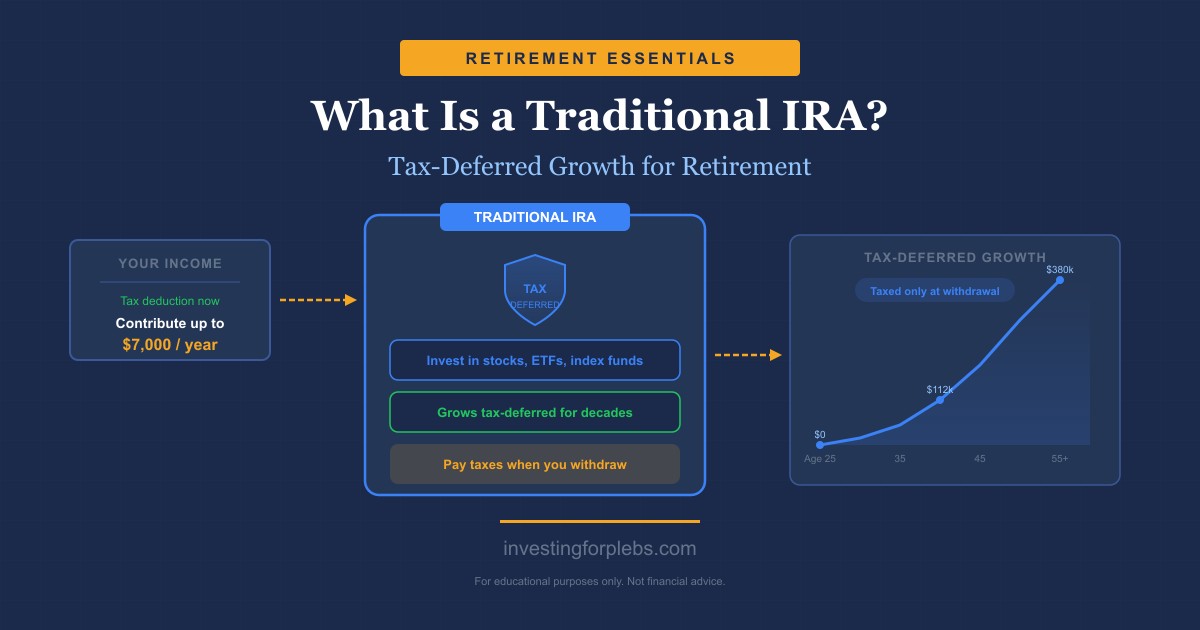
Traditional IRA: A retirement account funded with pre-tax dollars (contributions may be deductible). You pay taxes when you withdraw in retirement. Subject to required minimum distributions starting at age 73. Best for: investors who want a current-year tax deduction and expect to be in a lower bracket in retirement.
401(k): Employer-sponsored retirement account. You fund it through payroll deductions, and many employers match contributions up to a certain percentage. You can’t open a 401(k) yourself; it comes through your employer.
For most beginners, the practical starting path is: max out any employer 401(k) match first (it’s free money), then open a Roth IRA, and use a standard taxable brokerage account for anything beyond that. If you’re just getting started and not yet thinking about retirement, a standard taxable account works fine.
How to choose a broker
The good news: the basics are now commoditized. Almost every major online broker offers $0 trading commissions and $0 account minimums. The race to the bottom on fees happened a few years ago, and investors won.
What to look for:
- $0 commissions: You shouldn’t pay a fee to buy or sell a stock or ETF. This is now standard. If a broker charges commissions on basic trades, look elsewhere.
- $0 account minimum: You should be able to open and fund an account with any amount. No $2,500 minimums, no first-deposit requirements.
- Fractional shares: Lets you buy a dollar amount of a stock or ETF rather than whole shares. Critical if you want to invest in high-priced ETFs with a smaller starting amount.
- Investment options: Make sure the broker offers access to what you want to buy (index ETFs, individual stocks, etc.).
- Platform usability: You’ll be logging into this regularly. The interface should make sense to you.
Platforms like Fidelity, Charles Schwab, and Robinhood each offer these basics. This is not an endorsement of any specific broker; features and terms change, so verify the current fee schedule on their websites before you commit. Your goal is to find a platform you’ll actually use.
Step-by-step: how to open a brokerage account
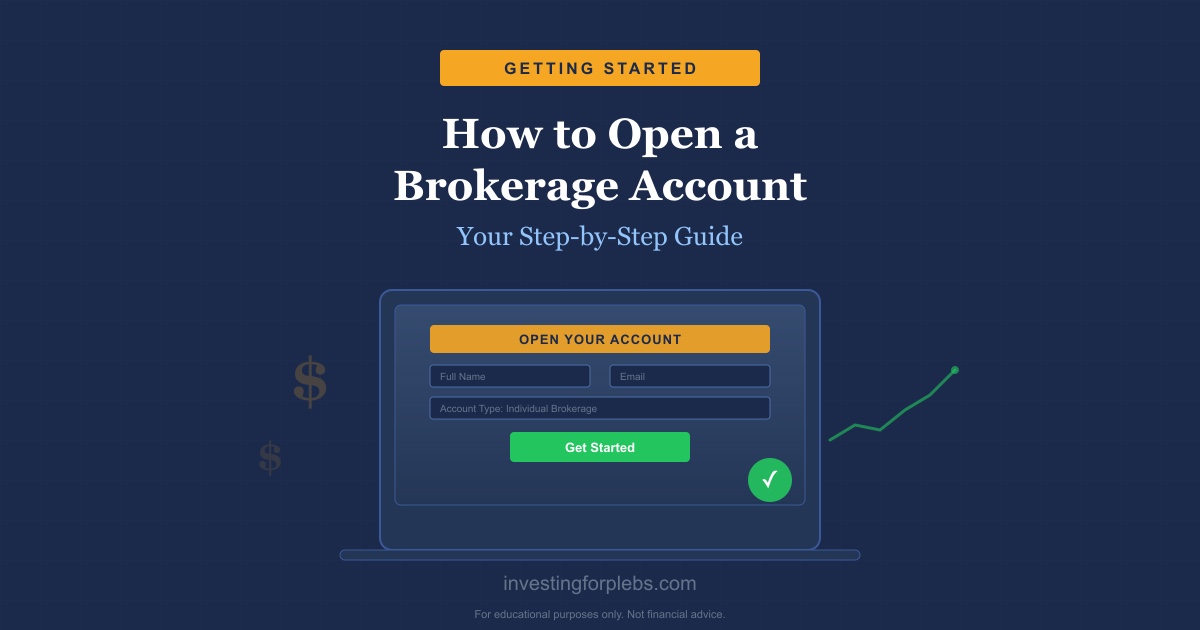
Here’s the actual process. It takes about 15 minutes.
Step 1: Pick a broker. Choose based on the criteria above. Go to their website directly, not a third-party link.
Step 2: Start the application. Most brokers have a “Open an Account” button on their homepage. Click it and choose your account type (taxable brokerage, Roth IRA, etc.).
Step 3: Fill out the application. You’ll need:
– Legal name, address, date of birth
– Social Security Number (required for tax reporting)
– Employment information
– Investment experience and risk tolerance (standard regulatory questions)
There’s typically a question about your investing goals and timeline. Answer honestly — it shapes what the platform suggests to you, but it doesn’t lock you into anything.
Step 4: Fund the account. Link your bank account (routing number and account number) and transfer money in. Most brokers offer ACH transfers, which are free but take 2-5 business days to settle. Some offer instant deposits for a limited amount.
Step 5: Make your first investment. Once your account is funded, you can buy investments. Search for the ETF or stock you want, enter the dollar amount or number of shares, review the order, and confirm.
That’s it. You’re now an investor.
What you need before you start
Gather these before you sit down to apply:
- Social Security Number: required for identity verification and tax reporting
- Bank account information: routing number and account number for the initial transfer
- 15 minutes: the application itself is quick
You do not need a large sum of money to start. With $0 minimums and fractional shares, you can open an account and make your first investment with $50 or $100. For ideas on what to do with that first small investment, see our guide on how to invest $100 for the first time.
Mistakes to avoid
Leaving your money in cash. A common error is funding the account and then stopping. The account itself doesn’t invest anything. You have to buy something. Money sitting as cash in a brokerage account earns almost nothing and accomplishes nothing.
Overcomplicating your first purchase. You don’t need a custom portfolio of 12 ETFs on day one. A single broad index ETF (one that tracks the S&P 500 or the total US market) is a perfectly defensible first investment. Understand the difference between ETFs and index funds before you buy: ETF vs. Index Fund: What’s the Actual Difference?
Waiting to start until you have “enough.” There is no magic threshold. Time in the market matters more than the amount you start with. Open the account today, fund it with whatever you have available, and invest it. The habit of regular contributions is more powerful than any single lump sum. Consider setting up automatic monthly contributions. That’s dollar-cost averaging in action, and it’s how most everyday investors build real wealth over time.
The entire process from “I should do this” to “account open and first investment made” can happen in a single afternoon. The only thing stopping most people is the assumption that it’s more complicated than it is.
It isn’t. Now you know exactly what to do.
This is educational content, not financial advice. All investing involves risk, including the possible loss of principal. Do your own research and consider your personal financial situation before making any investment decisions.
Enjoyed this? Get the Sunday Pleb every week — free market insights in plain English. Subscribe →
Sources: FINRA: Types of Brokerage Accounts | IRS: Roth IRAs | IRS: Traditional IRAs | SEC: Investor Bulletin — Opening an Account | SIPC: What SIPC Protects


Leave a Reply