
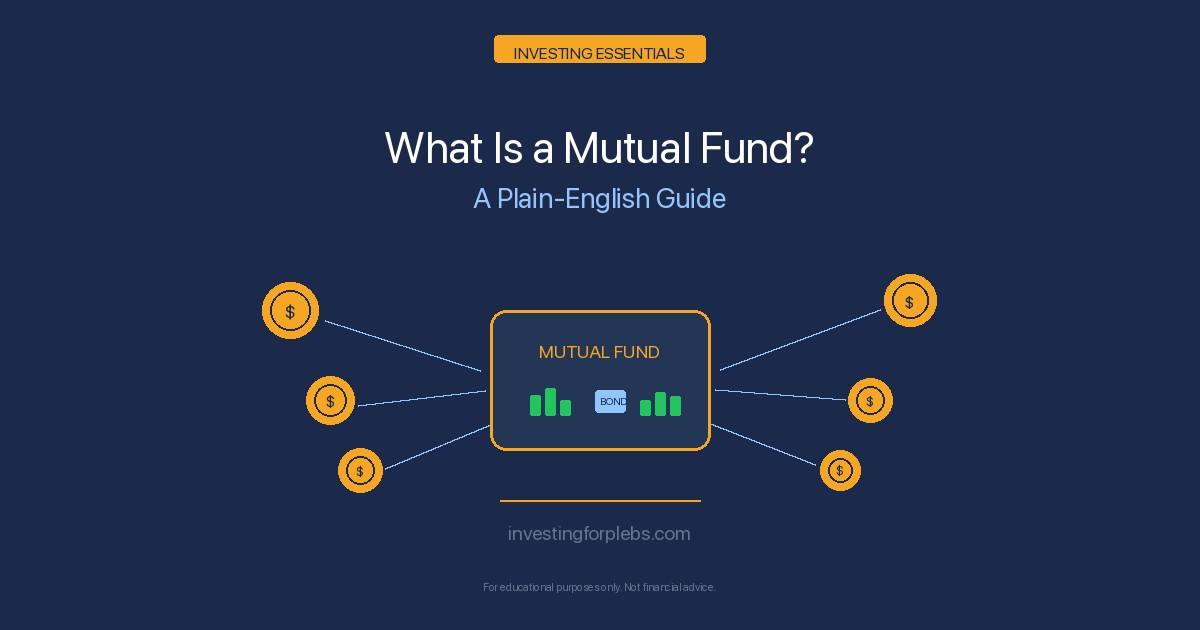
TL;DR: A mutual fund is a pool of money from many investors that gets invested in a collection of stocks, bonds, or other assets. You buy a share of that pool, instantly gaining exposure to dozens or hundreds of securities at once. Mutual funds are one of the most widely held investments in America, but understanding how they’re priced, what they cost, and how they differ from ETFs will help you decide if they belong in your portfolio.
Table of Contents
- What is a mutual fund?
- How do mutual funds work?
- Types of mutual funds
- Mutual fund fees explained
- Mutual funds vs ETFs — what is the difference?
- How to choose a mutual fund
- Are mutual funds good for beginners?
- Key takeaway
What is a mutual fund?
Imagine 10,000 people each putting $1,000 into a shared pot. A professional manager takes that $10 million and invests it across hundreds of companies. Every investor in the pool owns a proportional slice of everything in it. That’s a mutual fund.
Mutual funds exist because diversification is expensive to do yourself. Buying a meaningful stake in 50 different companies on your own requires capital, time, and ongoing attention that most people don’t have. Mutual funds let you outsource all of that for a fee.
The U.S. mutual fund industry holds over $20 trillion in assets, according to the Investment Company Institute. It’s one of the most widely used investment vehicles in the country, appearing in millions of 401(k) plans and IRAs precisely because it offers diversification at low entry points.
How do mutual funds work?
When you invest in a mutual fund, you’re buying shares (sometimes called units) in the fund. The price you pay per share is called the Net Asset Value (NAV).
NAV is calculated once per day, after the market closes. The formula is straightforward: take the total market value of everything the fund holds, subtract any liabilities, and divide by the number of outstanding shares. If a fund holds $100 million in assets and has 5 million shares outstanding, the NAV is $20 per share.
This daily pricing is one of the key ways mutual funds differ from stocks and ETFs, which trade at continuously changing prices throughout the trading day. With a mutual fund, you submit your buy or sell order during the day, but your trade executes at that evening’s NAV, whatever it turns out to be.
A fund manager (or a team of managers) decides what to buy and sell inside the fund. For actively managed funds, the manager is trying to beat a benchmark (the S&P 500, for example). For index funds (which are technically a type of mutual fund), the manager simply tracks an index without trying to outperform it.
When you own fund shares, you indirectly own all the underlying securities. You also share in the income. If the stocks in the fund pay dividends, that income flows to you. If the fund sells securities at a profit, you receive your share of the capital gains distribution.
Types of mutual funds
Not all mutual funds invest in the same things. Here are the main categories you’ll encounter:
Stock (equity) funds invest primarily in company shares. The broadest are total market or S&P 500 index funds. Narrower versions focus on specific sectors (technology, healthcare), geographies (international, emerging markets), or company sizes (small-cap, large-cap).
Bond funds invest in fixed-income securities. Corporate bond funds, which hold debt issued by companies, give you exposure to business credit without tying up cash in individual bonds. When evaluating bond funds, pay attention to the credit quality of the holdings (investment-grade vs. high-yield) and the average maturity, since both affect your risk profile. Unlike government bond funds, corporate bond funds are backed by the financial strength of individual businesses, which creates real accountability on the issuer side.
Money market funds hold short-term, highly liquid instruments. They’re not designed for growth; they’re designed for capital preservation and easy access. Think of them as a step up from a savings account.
Balanced (hybrid) funds hold a mix of stocks and bonds, often in a fixed ratio like 60/40. They provide built-in asset allocation in a single fund, which appeals to investors who want a one-stop portfolio.
Index funds track a market index like the S&P 500 or the Total Bond Market Index. They don’t try to pick winners. They just own whatever’s in the index, weighted accordingly. Because there’s no active stock-picking involved, they tend to have much lower fees.
Sector funds concentrate in a specific industry: energy, financials, healthcare, real estate. Higher potential return in a hot sector, but less diversification and more volatility.
Target-date funds automatically adjust their mix of stocks and bonds as you approach a specified retirement year. A “2050 fund” is aggressive today and becomes more conservative over time. They’re popular in 401(k) plans because they remove the burden of rebalancing.
Mutual fund fees explained
Fees are where many investors get hurt without realizing it. A seemingly small difference in fees compounds dramatically over decades.
Expense ratio
The most important number. The expense ratio is the annual fee the fund charges, expressed as a percentage of your assets. A fund with a 1% expense ratio charges you $10 per year for every $1,000 you have invested, deducted automatically from the fund’s returns, not from your account directly.
Actively managed funds typically charge between 0.5% and 1.5%. Index funds often charge 0.03% to 0.20%. That gap matters enormously. On a $50,000 investment over 30 years at a 7% average annual return:
- A fund with a 0.10% expense ratio grows to approximately $366,000
- A fund with a 1.00% expense ratio grows to approximately $287,000
That 0.9% annual difference costs you roughly $79,000. Fees matter.
Load funds vs. no-load funds
A load is a sales commission paid when you buy or sell fund shares.
- Front-end load: You pay the commission upfront. A 5% front-end load on a $10,000 investment means $500 goes to the broker before a single dollar is invested.
- Back-end load (also called a deferred sales charge): You pay when you sell, often phased out the longer you hold the fund.
- No-load funds: No sales commission. The full amount you invest goes to work immediately.
For most individual investors buying directly through a brokerage or employer retirement plan, no-load funds are the better choice. Loads compensate brokers for selling the fund, not the fund manager for managing it well.
12b-1 fees
A 12b-1 fee is a marketing and distribution fee baked into some funds’ expense ratios. It’s used to pay for advertising the fund or compensating advisors who recommend it. It’s disclosed in the fund’s prospectus. If you see it, ask yourself: are you paying to market the fund to other investors? That’s their cost, not yours.
Mutual funds vs ETFs — what is the difference?
This is one of the most common questions beginners ask, and the confusion is understandable because they’re structurally similar. Both pool money from investors into a collection of assets. But they work differently in a few important ways.
| Mutual Fund | ETF | |
|---|---|---|
| Trading | Once per day at NAV | Throughout the trading day, like a stock |
| Minimum investment | Often $500–$3,000 | Price of one share (sometimes $1 with fractional shares) |
| Tax efficiency | Lower (capital gains distributed to shareholders) | Higher (in-kind creation/redemption process limits taxable events) |
| Active vs. passive | Both, but actively managed are common | Majority are passive/index-tracking |
| Expense ratio | Varies widely; active funds often higher | Often lower, especially for index ETFs |
If you’re investing in a taxable brokerage account, ETFs tend to be more tax-efficient. If you’re investing inside a 401(k) or IRA (where taxes don’t apply in the same way), that advantage is less meaningful. Many retirement plans offer only mutual funds, not ETFs, so the choice may be made for you.
Both structures work. The differences are real, but not dramatic enough to obsess over, especially for long-term, buy-and-hold investors. For a deeper look at how ETFs compare to index funds specifically, see our ETF vs. index fund explainer. For a plain-English explainer on how ETFs work, see What Is an ETF?
How to choose a mutual fund
With thousands of mutual funds on the market, the choices feel overwhelming. Here’s a practical framework.
Start with your objective. What is this money for? Retirement in 30 years? A down payment in five? The timeline and purpose should drive the fund type. Long-term growth goals generally favor equity funds. Shorter timelines call for a more conservative mix.
Look at the expense ratio first. Before anything else. Low-cost index funds consistently outperform most actively managed funds over long periods, primarily because of the fee advantage. The arithmetic is relentless: lower costs mean more of the return stays with you.
No-load only, unless there’s a compelling reason. There almost never is. Loads compensate the salesperson, not the fund manager. Skip them.
For active funds, check the track record — skeptically. Most actively managed funds underperform their benchmark after fees over 10-plus year periods, per the SPIVA Scorecard published by S&P Global. If a manager has genuinely beaten the market consistently for a decade, that’s worth noting, but past performance doesn’t guarantee future results. And check: did they outperform after fees, or just before?
Understand what the fund actually holds. Two funds with similar names can have very different portfolios. A “large-cap growth fund” can hold wildly different stocks depending on the manager’s interpretation. Read the top holdings. Know what you own.
Check how it fits with the rest of your portfolio. If you already have an S&P 500 index fund, buying another large-cap U.S. stock fund doesn’t add diversification. It adds overlap. Think about what’s missing from your current mix before adding another fund.
If you’re adding to your position over time, dollar-cost averaging (investing a fixed amount at regular intervals) smooths out your entry price and removes the temptation to time the market.
Are mutual funds good for beginners?
Yes, with some nuance.
Mutual funds solve two of the biggest problems beginning investors face: they deliver instant diversification, and they remove the need to pick individual stocks. Instead of trying to figure out which company will win, you own a piece of many companies at once. That’s a sensible starting point.
The catch is fees. An actively managed mutual fund charging 1% per year is a structural disadvantage that compounds over time. For most beginners without access to a low-cost institutional fund (like the options inside a well-designed 401(k) plan), low-cost index funds, whether in mutual fund or ETF form, are the better default choice.
If you’re starting with a small amount, some mutual funds have minimum investment requirements that are higher than what you have available. ETFs can be more accessible in that case, especially with fractional share investing.
The right answer depends on your account type, what’s available to you, and your investment timeline. But for someone building a long-term portfolio for the first time, a low-cost index mutual fund is a perfectly solid foundation.
Key takeaway
A mutual fund is a pooled investment vehicle that lets you own a diversified collection of assets through a single purchase. They’ve made investing accessible to millions of people who couldn’t otherwise afford to build diversified portfolios on their own.
The structure works. What separates a good mutual fund choice from a bad one is mostly fees and fit. Keep costs low, understand what you’re buying, and make sure the fund matches your timeline and goals. When in doubt, a low-cost total market or S&P 500 index fund is a starting point that has served long-term investors well for decades.
This content is for educational purposes only and does not constitute financial advice. investingforplebs.com is not a registered investment advisor. Please consult a qualified financial professional before making investment decisions.
Enjoyed this? Get the Sunday Pleb every week: free market insights in plain English. Subscribe →
Sources: Investment Company Institute — 2025 Investment Company Fact Book | SPIVA U.S. Scorecard — S&P Global | SEC Investor Bulletin: Mutual Funds | FINRA: Mutual Funds


Leave a Reply