
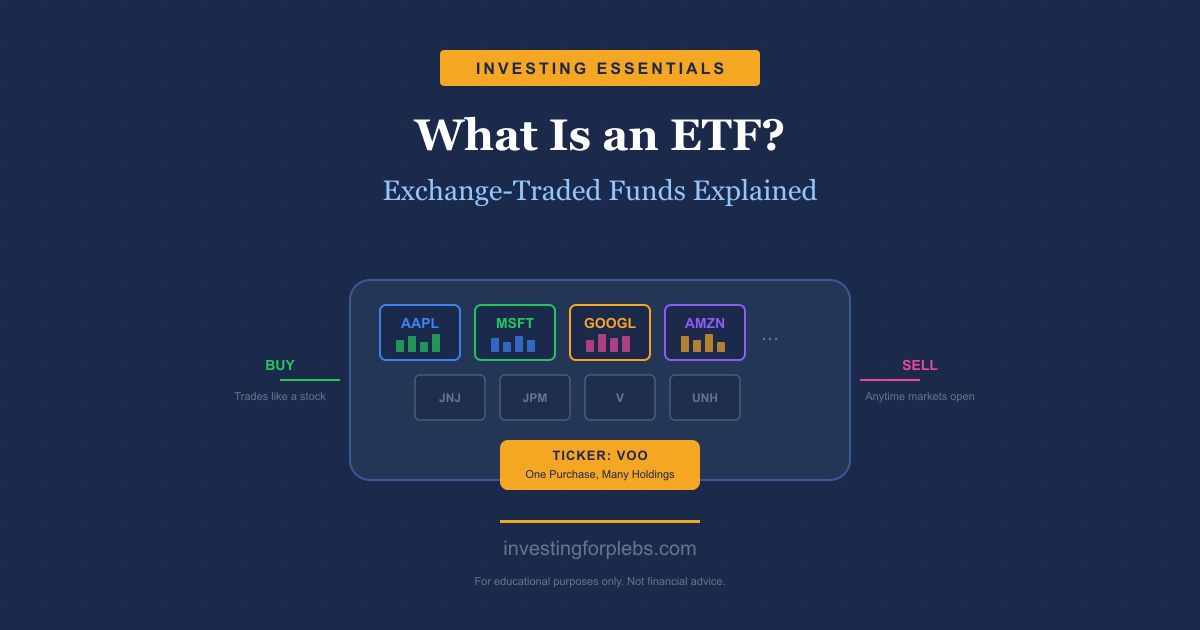
TL;DR: An ETF (exchange-traded fund) is a basket of investments that you can buy or sell on a stock exchange with a single ticker, just like a share of Apple or Tesla. One ETF can give you instant exposure to hundreds of companies, sectors, or asset classes. They’re low-cost, flexible, and beginner-friendly — and they’re one of the most important investing tools invented in the last 30 years.
Table of Contents
- What is an ETF?
- How do ETFs work?
- Types of ETFs
- How to buy an ETF
- Advantages of ETFs
- Risks to know
- Key takeaway
What is an ETF?
An exchange-traded fund is exactly what it sounds like: a fund (a collection of assets) that trades on an exchange (like the NYSE or Nasdaq).
When you buy a share of an ETF, you’re buying a slice of everything inside it. A single share of VTI (Vanguard Total Stock Market ETF) gives you proportional exposure to over 3,500 U.S. companies, from Apple down to small regional businesses. You get all of that with one transaction, one ticker, and typically a fee of less than 0.1% per year.
Before ETFs, getting that kind of broad diversification meant either buying into a mutual fund (which priced once a day and often had minimum investment requirements) or buying dozens of individual stocks (which was expensive and time-consuming). ETFs simplified the whole thing.
The first U.S. ETF, the SPDR S&P 500 ETF Trust (ticker: SPY), launched in 1993. Today, there are over 3,000 ETFs listed in the U.S., holding more than $10 trillion in assets, according to the Investment Company Institute.
How do ETFs work?
Under the hood, ETFs use a creation and redemption mechanism that keeps their market price close to the value of the underlying assets.
Here’s the simplified version: large financial institutions called “authorized participants” can create new ETF shares by delivering a basket of the underlying securities to the fund. They can also redeem ETF shares by exchanging them back for the underlying basket. This process means that if an ETF’s price drifts away from the value of what it holds, arbitrageurs can profit by closing the gap.
For practical purposes: the price you pay for an ETF is almost always very close to its net asset value (NAV), which is the per-share value of everything the fund holds. You don’t need to worry about paying a big premium.
Unlike mutual funds, which price once at the end of each trading day, ETFs trade throughout the day. You can place a buy order at 10am and see it execute at whatever the current market price is, just like buying a stock.
Most ETFs are passively managed, meaning they track an index rather than having a portfolio manager actively picking investments. A passively managed S&P 500 ETF simply holds all 500 companies in the index, weighted by market capitalization. No stock-picking involved.
Types of ETFs
Not all ETFs are the same. Here are the main categories you’ll encounter:
Index ETFs
The most common type. These track a market index: the S&P 500, the total U.S. stock market, the Nasdaq-100, an international index, and so on. They hold whatever’s in the index, in the same proportions.
Examples: VOO (S&P 500), VTI (Total U.S. Market), QQQ (Nasdaq-100), VEA (Developed international markets)
Because no one is actively picking stocks, the fees are rock-bottom. Many of the most popular index ETFs charge 0.03% to 0.07% per year.
Sector ETFs
These focus on a specific slice of the economy: technology, healthcare, energy, financials, consumer staples. They’re useful for investors who want to tilt toward (or away from) a particular industry without picking individual stocks.
Examples: XLK (Technology), XLE (Energy), XLV (Healthcare)
Sector ETFs concentrate your exposure, which means more potential upside in a hot sector and more downside if it falls out of favor. They’re generally less diversified than a total market ETF.
Bond ETFs
These hold a portfolio of bonds rather than stocks. Corporate bond ETFs, in particular, give you exposure to the debt of established companies, providing income and some ballast against equity volatility. The credit quality (investment-grade vs. high-yield) and the duration (how sensitive the fund is to interest rate changes) are the two key variables to understand before buying.
Examples: LQD (Investment-Grade Corporate Bonds), HYG (High-Yield Corporate Bonds)
International ETFs
Buying only U.S. stocks means you’re missing roughly 40% of global stock market market capitalization. International ETFs let you add exposure to developed markets (Europe, Japan, Australia) or emerging markets (India, Brazil, Taiwan).
Examples: VXUS (Total International Stock), EEM (Emerging Markets)
Thematic ETFs
These are a newer and more speculative category. Thematic ETFs target specific investment themes: artificial intelligence, clean energy, genomics, cybersecurity. They can be compelling stories. But they’re typically more concentrated, less diversified, and often carry higher fees than plain index ETFs.
Examples: ARKK (Active innovation strategy), ICLN (Clean energy)
Thematic ETFs are fine in small doses for investors who want exposure to a specific trend. They’re not a substitute for a core diversified holding.
Actively Managed ETFs
Some ETFs have a portfolio manager making decisions, rather than just tracking an index. They offer the tax efficiency and intraday trading of an ETF structure combined with active stock selection. They typically charge more than passive ETFs.
How to buy an ETF
Buying an ETF is the same process as buying any stock through a brokerage account. Here’s the basic flow:
- Open a brokerage account if you don’t already have one. Fidelity, Schwab, and Vanguard are the main low-cost options for most investors. (If you want a step-by-step guide, see how to open a brokerage account.)
- Fund the account by linking your bank and transferring money.
- Search for the ETF by ticker (e.g., “VOO”) or name.
- Place an order. For most investors, a market order (buy at the current price) is fine. If you want to control your entry price, use a limit order.
- Done. You now own a fractional piece of every company in the fund.
There are no investment minimums on ETFs: you buy however many shares you can afford. Many brokerages also allow fractional shares, meaning you can invest a fixed dollar amount (like $100) even if one full share costs more.
This makes ETFs well-suited for dollar-cost averaging: investing a consistent dollar amount at regular intervals, regardless of price. It’s one of the simplest and most effective habits a long-term investor can build.
Advantages of ETFs
Instant diversification. One purchase gives you exposure to dozens, hundreds, or thousands of securities. You’re not betting everything on a single company.
Low costs. The most popular index ETFs charge a fraction of what actively managed mutual funds charge. Over decades, that difference adds up to tens of thousands of dollars.
Tax efficiency. The in-kind creation/redemption mechanism means ETFs rarely distribute capital gains to shareholders, unlike traditional mutual funds. In a taxable account, this is a meaningful advantage. (See our ETF vs. index fund explainer for more detail on this.)
Transparency. Most ETFs publish their holdings daily, so you know exactly what you own.
Flexibility. You can buy or sell during market hours at the current price. No waiting for end-of-day NAV.
Accessibility. No minimums, fractional shares at most brokerages, and zero trading commissions at the major brokers. The barriers to entry are low.
Risks to know
ETFs are not risk-free. A few things to keep in mind:
Market risk. If the underlying assets fall in value, so does your ETF. A total stock market ETF will fall during a market downturn. That’s the deal you’re making in exchange for long-term returns. This is expected, not a malfunction.
Liquidity risk on niche ETFs. The major index ETFs (VOO, VTI, SPY) trade billions of dollars per day. But some niche or thematic ETFs trade very little volume, which means the bid-ask spread (the gap between what buyers and sellers offer) can be wide. Stick to ETFs with reasonable daily trading volume.
Concentration risk in sector/thematic ETFs. A broad index ETF diversifies you. A single-sector ETF concentrates you. Understand what you’re buying.
Fee creep. Not all ETFs are cheap. Some actively managed or thematic ETFs charge 0.5% to 0.75% per year. That’s not outrageous, but it’s much higher than a plain vanilla index ETF charging 0.03%. Always check the expense ratio before buying.
Tracking error. Most ETFs closely follow their index, but some deviate slightly due to fees, trading costs, or imprecise replication. For major index ETFs, this is trivial. For smaller or synthetic ETFs, it can be more meaningful.
Key takeaway
An ETF lets you own a diversified basket of investments through a single purchase, traded like a stock, at costs that were unimaginable 30 years ago. For most long-term investors, a handful of low-cost index ETFs covering the broad U.S. market, international markets, and possibly corporate bonds covers the essential ground.
The variety of ETFs is enormous — some are brilliant tools, some are expensive gimmicks. The filter is simple: understand what’s inside it, what it costs, and whether the level of concentration fits your overall portfolio. A low-cost, broad-market ETF is hard to improve on for most investors who are building wealth over time.
This content is for educational purposes only and does not constitute financial advice. investingforplebs.com is not a registered investment advisor. Please consult a qualified financial professional before making investment decisions.
Enjoyed this? Get the Sunday Pleb every week — free market insights in plain English. Subscribe →
Sources: Investment Company Institute — 2025 Investment Company Fact Book | SEC: Exchange-Traded Funds | Morningstar ETF Research | FINRA: ETF Basics
Leave a Reply