
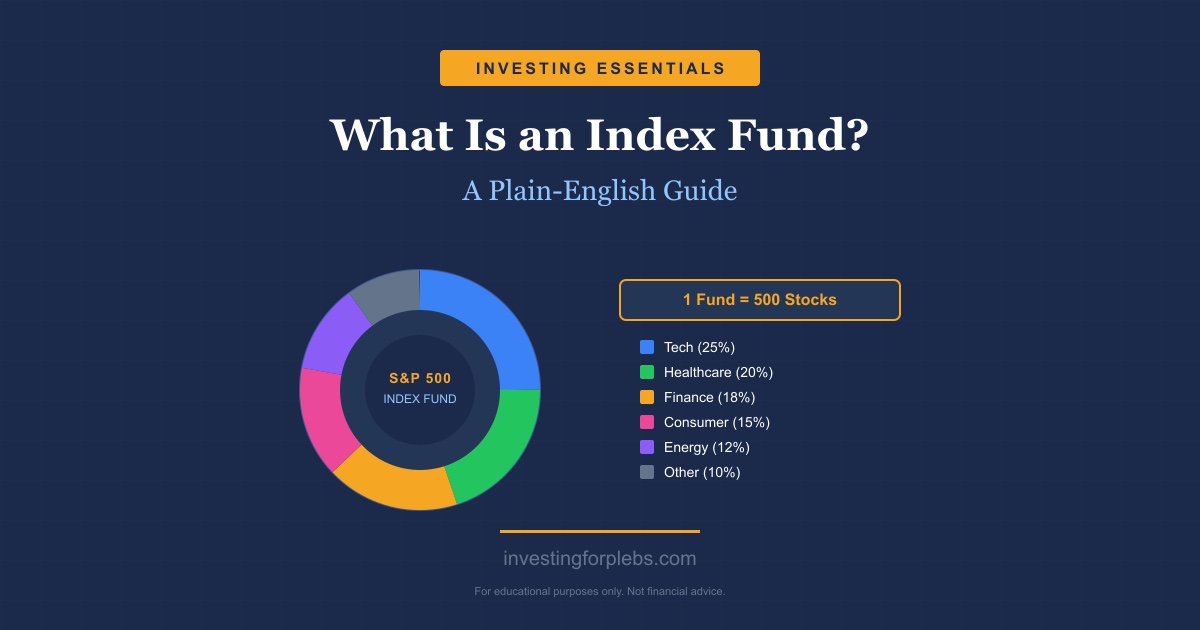
TL;DR: An index fund is a fund that tracks a market index (like the S&P 500) by buying the stocks in that index instead of having a manager pick them. The result: instant diversification, very low costs, and performance that matches the market. Over long periods, most actively managed funds fail to beat a simple index fund. That’s why index funds have become the default recommendation for most everyday investors.
Table of Contents
- What is an index fund?
- What is a market index?
- How index funds work
- Why fees matter so much
- Index funds vs. actively managed funds
- Common index funds beginners should know
- How to buy an index fund
- When index funds make sense (and when they don’t)
- Key takeaway
What is an index fund?
An index fund is a type of investment fund that tracks a market index by holding the same securities as that index, in the same proportions.
Instead of employing a team of analysts to hunt for the next great stock, an index fund takes a simpler approach: figure out what’s in the index, buy all of it, and don’t overthink it. The fund’s goal isn’t to beat the market. It’s to match it.
This passive approach turns out to be extremely effective. According to the SPIVA Scorecard published by S&P Global, over 15 years, roughly 88% of actively managed large-cap U.S. funds underperformed the S&P 500. Most professional stock-pickers, with all their research and resources, didn’t beat a fund that simply owned the index.
Index funds come in two structural forms: traditional mutual funds (like Vanguard’s VFIAX) and ETFs (like Vanguard’s VOO). Both track the same index; the difference is how they trade. For a detailed breakdown of that distinction, see our ETF vs. index fund explainer.
What is a market index?
Before you can understand index funds, you need to understand what an index is.
A market index is a list of securities that represent a slice of the market. It’s a benchmark, a measuring stick for how a particular segment of the market is performing.
The most widely followed indexes:
- S&P 500: The 500 largest publicly traded U.S. companies, weighted by market capitalization. When people say “the market went up 2% today,” they usually mean the S&P 500.
- Dow Jones Industrial Average (DJIA): 30 large, blue-chip U.S. companies. Older and narrower than the S&P 500. Less representative of the broader market.
- Nasdaq-100: The 100 largest non-financial companies listed on the Nasdaq exchange. Heavily weighted toward technology.
- Russell 2000: 2,000 smaller U.S. companies. Used to track small-cap stocks.
- MSCI World: Large and mid-cap stocks across 23 developed countries. Used for global exposure.
An index fund that tracks the S&P 500, for example, buys all 500 companies in that index (or a representative sample of them) weighted by their size. When Apple makes up roughly 7% of the S&P 500, a well-run S&P 500 index fund holds roughly 7% in Apple.
How index funds work
When you invest in an index fund, here’s what happens:
- Your money goes into the fund along with money from thousands of other investors.
- The fund uses that pool of money to buy the securities in its target index.
- The fund’s value rises and falls as the underlying securities rise and fall.
- You own a proportional share of everything in the fund.
Because the fund isn’t making active decisions about what to buy and sell, there’s very little trading activity. This has a few practical benefits:
Low costs. Active management is expensive. Research teams, portfolio managers, and frequent trading all add up. Index funds don’t need much of that, which is why their fees (called expense ratios) are a fraction of what active funds charge.
Built-in diversification. Owning an S&P 500 index fund means you own a piece of 500 different companies across dozens of industries. That’s meaningful diversification in a single purchase.
Tax efficiency. Because index funds don’t trade frequently, they generate fewer taxable capital gains distributions. This matters most in taxable brokerage accounts.
Why fees matter so much
The expense ratio is the annual fee the fund charges, expressed as a percentage of your investment. It’s deducted automatically from fund returns. You never write a check, but you feel it over time.
Consider this: a $50,000 investment held for 30 years at a 7% average annual return:
| Expense Ratio | Ending Value |
|---|---|
| 0.03% (typical index fund) | ~$375,000 |
| 0.10% (low-cost index fund) | ~$366,000 |
| 1.00% (typical active fund) | ~$304,000 |
The difference between a 0.03% index fund and a 1.00% active fund is roughly $71,000 on a $50,000 investment over 30 years. The fee isn’t small; it’s enormous. And that’s before accounting for the fact that most active funds also underperform their benchmark.
This math is why low-cost index funds have become the default recommendation for long-term investors.
Index funds vs. actively managed funds
Actively managed funds employ professional managers who research companies and try to pick winners. The argument for them: a skilled manager, with access to better research and faster information, can beat the market.
The data, unfortunately, mostly doesn’t support that argument.
Per the SPIVA Scorecard, over a 20-year horizon, more than 94% of actively managed U.S. equity funds underperformed their benchmark after fees. The managers aren’t necessarily bad at picking stocks. The problem is that the fees they charge erase whatever advantage they might have, and then some.
There are exceptions. Some active strategies, particularly in less efficient corners of the market like small-cap international stocks, have shown more promise. But for the core of most portfolios (broad U.S. market exposure), the passive index approach has a strong record.
The comparison isn’t really “good manager vs. bad manager.” It’s fees vs. returns. When you analyze a stock yourself, you’re competing with professionals who do it full-time. When you buy an index fund, you stop competing and start owning a piece of the whole game.
Common index funds beginners should know
You don’t need to pick between dozens of options to get started. A handful of broad, low-cost index funds cover most of what most investors need.
For U.S. stock market exposure:
– VOO (Vanguard S&P 500 ETF): 0.03% expense ratio. Tracks the S&P 500.
– IVV (iShares Core S&P 500 ETF): 0.03% expense ratio. Also tracks the S&P 500.
– VTI (Vanguard Total Stock Market ETF): 0.03% expense ratio. Broader than S&P 500; includes mid- and small-cap U.S. stocks.
– FXAIX (Fidelity 500 Index Fund): 0.015% expense ratio. Mutual fund version of an S&P 500 tracker; no investment minimum.
For international exposure:
– VXUS (Vanguard Total International Stock ETF): 0.07% expense ratio. Covers developed and emerging market stocks outside the U.S.
– VEA (Vanguard Developed Markets ETF): 0.03% expense ratio. Developed international markets.
These aren’t recommendations; they’re examples of the types of broad, low-cost index funds that appear in most beginner investor discussions. What’s right for you depends on your goals, timeline, and overall portfolio. This is also not financial advice.
How to buy an index fund
Buying an index fund is straightforward if you have a brokerage account.
Step 1: Open a brokerage account if you don’t have one. For tax-advantaged investing, that means a 401(k) through your employer or an IRA you open yourself (Roth or Traditional). For taxable investing, a regular brokerage account at Fidelity, Schwab, or Vanguard works.
Step 2: Search for the fund by ticker symbol (e.g., “VOO”) or by its full name.
Step 3: Decide how much to invest. For ETFs, you’ll buy by share count or dollar amount (if your brokerage supports fractional shares). For mutual fund versions, you may need to meet a minimum investment, though many brokerages have eliminated those requirements.
Step 4: Place the order. For ETFs, you’re buying at the current market price. For mutual funds, your order executes at the end-of-day NAV.
Step 5: Set it and keep going. The biggest advantage of index funds is that they reward consistency. Investing a fixed amount regularly, rather than trying to time the market, is how dollar-cost averaging works, and it’s one of the simplest investing habits you can build. Even starting with $100 gets the habit going.
When index funds make sense (and when they don’t)
Index funds are well-suited for:
- Long-term goals (retirement, generational wealth) where time in the market matters more than tactical moves
- Investors who don’t want to research individual companies: the fund does the work for you
- Tax-advantaged accounts (401(k), IRA), where you’re building wealth over decades
- Core portfolio positions that anchor a broader strategy
They’re less ideal as your only tool if:
- You’re specifically trying to express a view on a single company or sector
- You want to hold cash for a short-term goal (for that, consider high-yield savings or money market accounts)
- Your time horizon is very short, where sequence risk matters more than long-run compounding
For most people building wealth over time, the case for keeping most of your equity exposure in low-cost index funds is well-supported by the historical data. That doesn’t mean you can’t also own individual stocks, but for the core of a long-term portfolio, the index approach has a strong track record.
Key takeaway
An index fund tracks a market index by holding its underlying securities instead of having a manager pick stocks. The result: broad diversification, very low costs, and returns that match the market. Because most actively managed funds fail to beat the market after fees over the long run, index funds have become the foundation of most sensible long-term investing strategies.
To understand how index funds compare to ETFs specifically, see ETF vs. Index Fund: What’s the Actual Difference?
This content is for educational purposes only and does not constitute financial advice. investingforplebs.com is not a registered investment advisor. Please consult a qualified financial professional before making investment decisions.
Enjoyed this? Get the Sunday Pleb every week: free market insights in plain English. Subscribe →
Sources: SPIVA U.S. Scorecard — S&P Global | SEC: Index Funds | Investment Company Institute — 2025 Fact Book | Vanguard: The Case for Index Fund Investing
Leave a Reply