
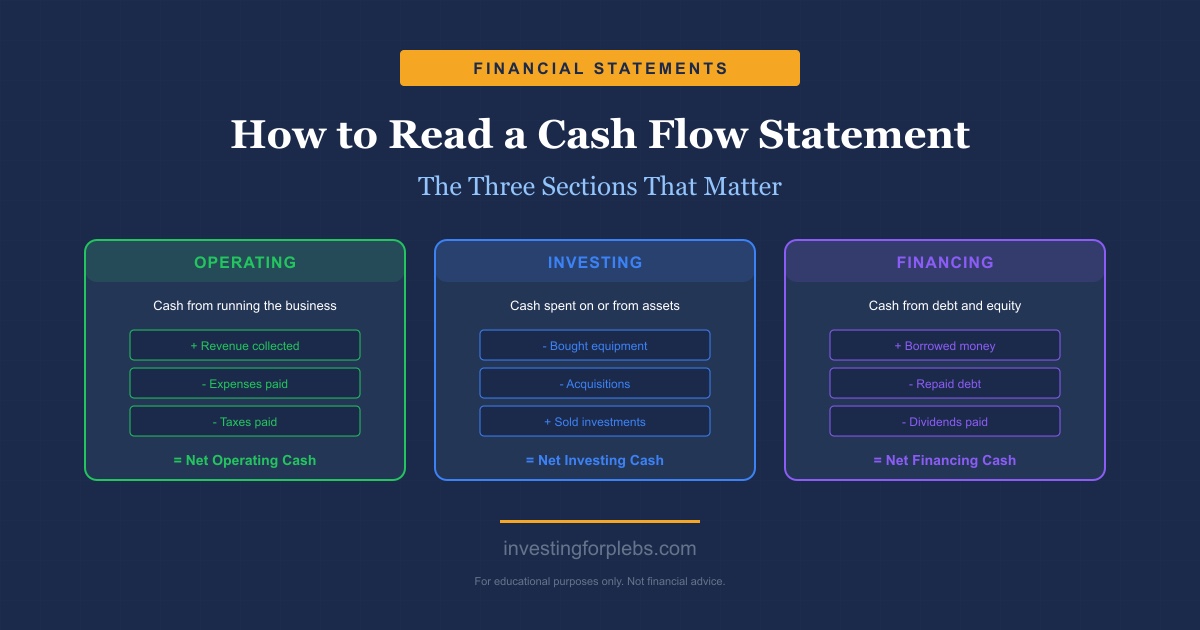
TL;DR: The cash flow statement tells you how much actual cash moved in and out of a company during a period, and explains why. It has three sections: operating (cash from running the business), investing (cash spent on or received from assets), and financing (cash from borrowing, repaying debt, or returning money to shareholders). Together, these three numbers tell a more honest story about a company’s financial health than earnings alone.
Why the Cash Flow Statement Matters
Most people start with the income statement when analyzing a company. That’s reasonable — it shows revenue and profit. But there’s a catch: the income statement follows accounting rules that allow for some flexibility in how and when things get recorded. Revenue can be recognized before cash actually arrives. Expenses can be smoothed out over time.
The cash flow statement cuts through all of that. Cash either moved or it didn’t. You can’t book “potential cash” or defer a cash payment on paper. This is why experienced investors almost always check the cash flow statement alongside earnings.
Think of it as the receipt. The income statement says what you were charged. The cash flow statement says what you actually paid.
The Three Sections
Every cash flow statement is divided into three distinct sections. Each one answers a different question about where the money went.
1. Operating Activities: Is the core business generating cash?
This section shows the cash generated by (or consumed by) the company’s day-to-day operations. Running the business, selling products, collecting from customers, paying suppliers and employees: all of that shows up here.
It starts with net income (pulled from the income statement) and then adjusts for two things:
- Non-cash charges: Depreciation is the most common. When a company buys a machine, it doesn’t expense the full cost immediately; instead, it spreads the cost over the asset’s useful life. That depreciation reduces reported earnings but doesn’t cost cash. So it gets added back here.
- Working capital changes: If a company sells more on credit, its accounts receivable grows (it’s owed money but hasn’t collected it yet). That’s cash that hasn’t arrived, so it reduces operating cash flow. Conversely, if the company delays paying its suppliers, accounts payable grows, and that’s cash the company is holding onto temporarily.
What to look for: Consistently positive operating cash flow is the sign of a business that actually works. If a company reports profits but operating cash flow is consistently negative, something is worth investigating.
2. Investing Activities: What is the company buying and selling?
This section covers cash spent on or received from long-term assets: buying equipment, building facilities, acquiring other companies, or selling assets. You’ll also see purchases or sales of investments (like marketable securities) here.
The big line item is usually capital expenditures (capex): the cash a company spends to maintain and grow its physical infrastructure. This is the number you subtract from operating cash flow to calculate free cash flow.
What to look for: High capex isn’t automatically bad. A company investing heavily in new capacity is making a bet on future growth. But capex that consistently exceeds operating cash flow is a warning sign. The company may be burning through cash without generating enough return.
Also watch for companies propping up cash flow by selling assets. If operating cash flow is weak but total cash is stable because the company keeps selling off pieces of itself, that’s not a sustainable picture.
3. Financing Activities: How is the company funding itself?
This section tracks cash flows related to the company’s capital structure: borrowing money, repaying debt, issuing new shares, buying back stock, and paying dividends.
Common line items:
– Proceeds from debt issuance: Cash coming in from new loans or bonds
– Repayment of debt: Cash going out to pay off borrowings
– Stock issuances: Cash raised by selling new shares to investors
– Share repurchases: Cash spent buying back the company’s own stock
– Dividends paid: Cash returned directly to shareholders
What to look for: If a company’s operating activities aren’t generating enough cash, it may fund itself by constantly issuing debt or new shares. That’s not always bad — plenty of high-growth companies operate this way for years. But it’s useful to know whether a business is self-funding or dependent on external capital.
A Simple Example: Apex Brands Inc.
Let’s say Apex Brands Inc. reports the following on its cash flow statement (in millions):
Operating Activities
– Net income: $500
– Add: Depreciation: $80
– Change in working capital: -$30
– Cash from operations: $550
Investing Activities
– Capital expenditures: -$200
– Acquisition of competitor: -$150
– Cash used in investing: -$350
Financing Activities
– Dividends paid: -$100
– Share repurchases: -$50
– Cash used in financing: -$150
Net change in cash: +$50
What does this tell us? The business generates solid cash from operations ($550M). It’s investing heavily, buying equipment and making an acquisition. After paying dividends and buying back stock, cash on hand grew by $50M. That’s a reasonably healthy picture for a mature, growing company.
Now compare this to a company with $500M in net income but only $50M in operating cash flow. The gap between earnings and actual cash collected is a red flag worth investigating.
How the Three Statements Work Together
The cash flow statement doesn’t exist in isolation. It connects directly to the other two financial statements:
- Income statement: Net income from the income statement is the starting point for operating activities
- Balance sheet: The ending cash balance on the cash flow statement matches the cash line on the balance sheet
Understanding how they fit together is fundamental to reading an earnings report properly. The income statement tells you what the company earned; the balance sheet tells you what it owns and owes; the cash flow statement tells you how real the earnings actually are.
Key Takeaway
A cash flow statement has three sections: operating (cash from running the business), investing (cash spent or received on long-term assets), and financing (cash from debt and equity transactions). Together they tell you whether a company’s profits are real, whether it’s investing in future growth, and how it’s funding itself.
If you only have time to look at one number, look at cash from operations. Consistent, growing operating cash flow is one of the clearest signs of a healthy business. And once you understand the investing section, you’re one subtraction away from understanding free cash flow — the number analysts often trust most.
This content is for educational purposes only and does not constitute financial advice. investingforplebs.com is not a registered investment advisor. Please consult a qualified financial professional before making investment decisions.
Enjoyed this? Get the Sunday Pleb every week: free market insights in plain English. Subscribe →
Sources: SEC: Financial Reporting Manual — Cash Flow Statements | FASB ASC 230: Statement of Cash Flows | CFA Institute: Reading Financial Statements



Leave a Reply