
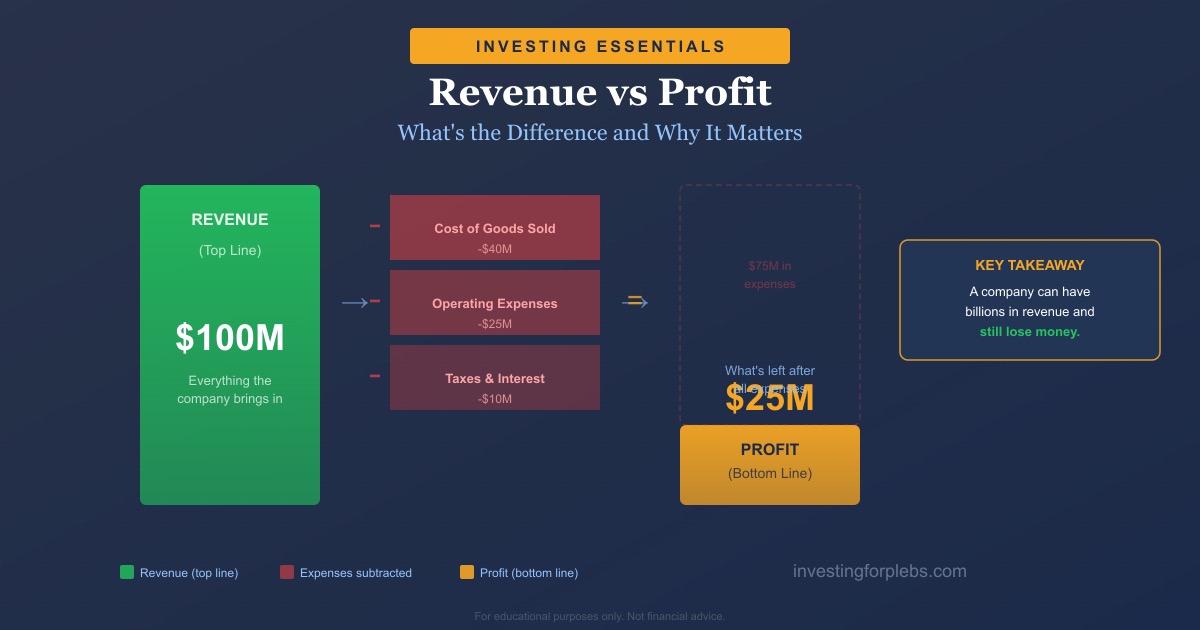
TL;DR: Revenue is everything a company brings in. Profit is what’s left after expenses. A company can have billions in revenue and still lose money. Understanding the gap between the two is one of the most important skills you can develop as an investor.
Table of Contents
- Why this matters before anything else
- What is revenue?
- What is profit? The three layers
- The lemonade stand example
- How a billion-dollar company can still lose money
- Why it matters for investors
- Key takeaway
Why this matters before anything else
Before you can read a financial statement, analyze a stock, or understand an earnings report, you need to know the difference between revenue and profit.
They’re not the same. Not even close. And confusing them leads to bad decisions.
When a company reports “record revenue,” that sounds great. But if expenses grew even faster, the company is actually bleeding money. Revenue without context can be misleading. Profit without revenue context can be too.
Here’s how to read both correctly.
What is revenue?
Revenue is the total amount of money a company takes in from selling its products or services, before any expenses are subtracted.
It’s sometimes called the “top line” because it sits at the top of the income statement, before costs start getting deducted.
Revenue is purely a sales number. It says nothing about whether the company is making money. A shoe company with $500 million in revenue could be wildly profitable or deeply unprofitable, depending on what it costs to run the business.
You’ll sometimes see “revenue” used interchangeably with “sales” or “net sales.” For most purposes, they mean the same thing.
What is profit? The three layers
Once you have revenue, expenses start coming out. What’s left is profit. But there are three different “profits” on an income statement, and each one tells you something different.
Gross profit
Gross profit = Revenue minus the cost of goods sold (COGS)
COGS is the direct cost of making what you sell: raw materials, manufacturing labor, the ingredients in the food, the fabric in the clothes. Strip that out and you get gross profit.
Gross profit tells you how efficiently a company converts sales into earnings, before all the overhead kicks in. A high gross profit margin (gross profit as a percentage of revenue) usually means pricing power or a lean production process.
Operating profit
Operating profit = Gross profit minus operating expenses
Operating expenses include everything else it costs to run the business day-to-day: salaries, rent, marketing, research and development, depreciation. These are the costs that don’t directly go into making a product but are required to keep the lights on.
Operating profit (also called EBIT, or earnings before interest and taxes) shows whether the core business itself is profitable, before financing costs and tax come into play.
Net profit
Net profit = Operating profit minus interest and taxes
Net profit (also called “net income” or the “bottom line”) is the final number after everything has been accounted for. This is what most people mean when they simply say “profit.” It’s the foundation of earnings per share (EPS), the number Wall Street focuses on most during earnings season.
The lemonade stand example
Let’s say you run a lemonade stand.
On a Saturday, you sell 100 cups at $2 each. Your revenue is $200.
But making those 100 cups cost you $80 in lemons, sugar, and cups. Your gross profit is $120 ($200 minus $80).
You also paid $30 for the table, the sign, and advertising around the neighborhood. Subtract that, and your operating profit is $90.
Your parents loan you $10 to buy supplies, and you owe them $1 in interest. You’re also in a state that taxes lemonade stand income at 10%, so you owe $8.90 in tax.
After all of that, your net profit is $80.10.
You had $200 in revenue. You walked away with $80.10. Very different numbers. Very different stories.
How a billion-dollar company can still lose money
Amazon spent most of its first decade as a public company losing money, despite enormous revenue growth. In 2014, Amazon reported over $88 billion in revenue and posted a net loss of $241 million. Revenue was massive. Profit was negative.
Why? Because Amazon was plowing money into warehouses, technology, and new business lines faster than it was earning from existing ones. High revenue, but higher expenses.
This pattern is common in tech companies, particularly early-stage or high-growth businesses. They may have strong top-line growth and terrible bottom-line results by design, investing heavily in future scale.
None of that is automatically good or bad. But if you only looked at revenue, you’d miss the full picture entirely.
This is also why cash flow matters alongside profit. Net income is an accounting figure. A company can report positive net income while burning through cash, thanks to how revenue and expenses get recognized on the books. Free cash flow is often the more honest look at whether the business is actually generating money it can use.
Why it matters for investors
When you’re evaluating a company, here’s what to look for at each layer:
Revenue growth: Is the company bringing in more money over time? Flat or declining revenue is a warning sign, even if the company is currently profitable. A business that can’t grow its top line will eventually struggle.
Gross margin trends: Is the company keeping more of each sales dollar after production costs? If gross margins are shrinking, it might mean rising input costs, pricing pressure from competitors, or a shift to lower-margin products. Gross margin is often a proxy for competitive strength.
Operating profit margin: After paying employees, running marketing campaigns, and investing in R&D, is the business making money? If revenue is growing but operating profit is not, expenses may be scaling out of control.
Net profit: The final score. But don’t look at it in isolation. Check whether net income growth is coming from operating improvements or one-time items like asset sales or tax adjustments.
Revenue vs. profit growth together: A healthy company should show both growing over time. If revenue grows but profit doesn’t, that’s worth investigating. If profit grows but revenue doesn’t, ask how: buybacks, cost cuts, and accounting moves can all temporarily boost the bottom line without building a better business.
One more thing: when you see headlines about a company “beating earnings,” they’re almost always talking about earnings per share (EPS), which is derived from net income. Understanding where that number comes from, starting with revenue at the top and working down, is how you evaluate whether a “beat” is meaningful or paper-thin.
Key takeaway
Revenue is the total money in. Profit is what’s left after costs. In between those two numbers is the whole story of how a business operates.
A company with high revenue and thin profit is making a lot of sales but keeping very little. A company with rising revenue and expanding profit margins is building something durable. And a company with declining revenue but stable profit is probably cutting costs, not growing.
Neither number alone tells the full story. Together, they start to paint one.
Read them both. Watch how they change over time. And the next time a company announces “record revenue,” you’ll know exactly what question to ask next: OK, but what about profit?
This content is for educational purposes only and does not constitute financial advice. investingforplebs.com is not a registered investment advisor. Please consult a qualified financial professional before making investment decisions.
Enjoyed this? Get the Sunday Pleb every week — free market insights in plain English. Subscribe →


Leave a Reply