
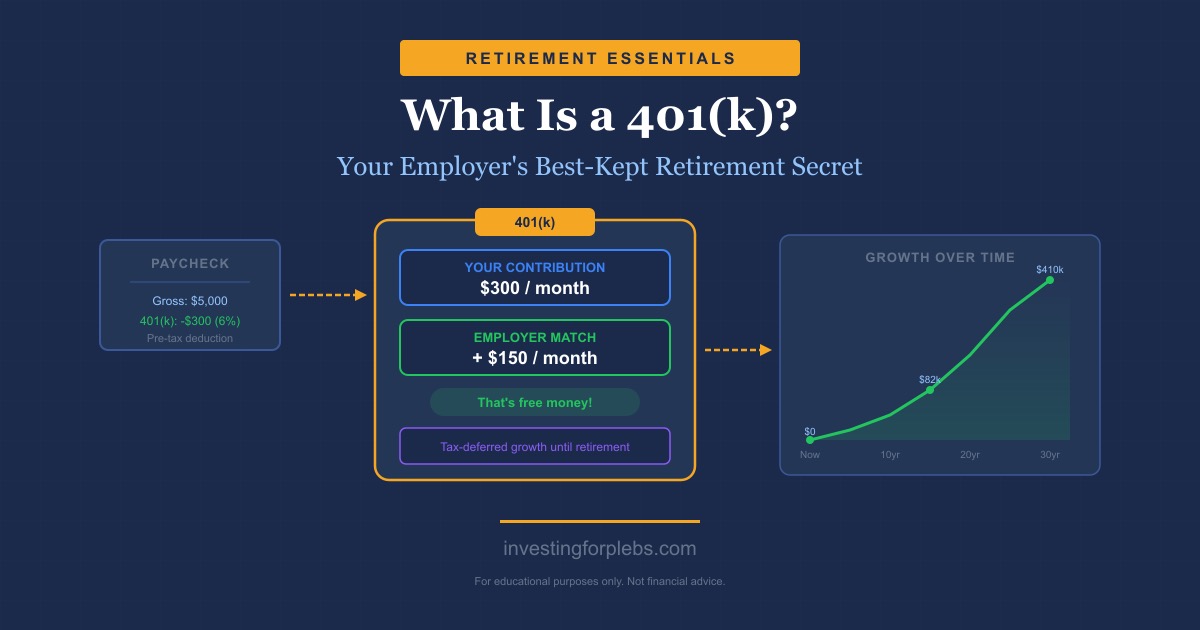
There’s a number on your pay stub that a lot of people ignore: the one next to “401(k) contribution.” That’s a mistake. A 401(k) is one of the most powerful savings tools the tax code has ever handed to ordinary workers, and millions of people leave thousands of dollars on the table every year by not fully understanding it.
This guide breaks it all down simply: what a 401(k) actually is, how the tax benefits work, what “employer match” really means, and what to do if you’ve never touched yours.
What Is a 401(k)?
A 401(k) is a retirement savings account sponsored by your employer. You contribute money from your paycheck, it gets invested, and it grows over time until you’re ready to retire. The name comes from Section 401(k) of the U.S. Internal Revenue Code — which is exactly as dry as it sounds, but the benefits are anything but.
The key thing that makes a 401(k) different from a regular savings account is the tax treatment. The government gives you a significant break to encourage long-term retirement saving. Depending on which type you choose, you either save on taxes today or avoid them in retirement.
How a 401(k) Works
Here’s the basic flow:
- You tell your employer what percentage of your paycheck you want to contribute.
- That money is automatically deducted before it hits your bank account.
- The funds get invested in a menu of options your employer selects, usually a mix of stock funds, bond funds, and target-date funds.
- The money grows tax-advantaged until you withdraw it in retirement.
With a Traditional 401(k) (the most common type), your contributions come out of your paycheck before income taxes are calculated. If you earn $60,000 and contribute $6,000, you only pay income taxes on $54,000 that year. That’s real money back in your pocket now.
The growth inside the account is tax-deferred — meaning you don’t pay taxes on the gains, dividends, or interest until you withdraw the money in retirement. By then, many people are in a lower tax bracket, which makes the eventual tax bill smaller.
The Employer Match: This Is Literally Free Money
If your employer offers a 401(k) match, this is the most important part of the whole article. Pay attention.
A typical employer match looks something like this: “We’ll match 100% of your contributions up to 4% of your salary.” That means if you earn $60,000 and you contribute at least $2,400 (4% of your salary), your employer adds another $2,400 to your account. For free.
That’s an instant 100% return on the first 4% you contribute. No investment in the world reliably delivers that.
Not contributing enough to capture your full employer match is one of the most common and costly financial mistakes working people make. Before you do anything else with your investing life, read The Complete Beginner’s Guide to Investing for the full picture, and make sure you’re getting every dollar of that match.
Your specific match formula will be in your benefits documents or your HR portal. Look it up this week if you haven’t already.
Contribution Limits
The IRS sets caps on how much you can contribute to a 401(k) each year. For 2025, the employee contribution limit is $23,500. If you’re age 50 or older, you can contribute an additional $7,500 as a “catch-up contribution,” bringing your total to $31,000.
A new rule from the SECURE 2.0 Act applies to workers aged 60 to 63 specifically: your catch-up limit increases to $11,250 in 2025, for a total of $34,750. That’s a meaningful boost for people ramping up savings in the final stretch before retirement.
These limits apply only to your contributions; your employer’s match doesn’t count toward your cap. The combined total (your contributions + employer match) has a higher separate limit set by the IRS.
Note: Contribution limits are adjusted annually for inflation. Check the IRS website each year for the updated figures.
Traditional 401(k) vs. Roth 401(k)
Many employers now offer both options. The difference comes down to when you pay taxes.
| Traditional 401(k) | Roth 401(k) | |
|---|---|---|
| Contributions | Pre-tax (reduces taxable income now) | After-tax (no immediate tax break) |
| Growth | Tax-deferred | Tax-free |
| Withdrawals in retirement | Taxed as ordinary income | Tax-free |
Traditional 401(k): You pay taxes later, when you withdraw the money. This is better if you expect to be in a lower tax bracket in retirement than you are today.
Roth 401(k): You pay taxes now, on the money before it goes in. Your withdrawals in retirement are completely tax-free. This is generally better if you expect to be in a higher tax bracket in retirement, or if you’re early in your career and currently in a lower bracket.
Neither is universally better. If you’re young and just starting out, the Roth 401(k) is often worth considering because you’re likely in a relatively low tax bracket. If you’re in your peak earning years, the pre-tax deduction of a traditional 401(k) can provide meaningful tax relief now.
What Happens When You Leave a Job?
Your 401(k) money is yours. It doesn’t disappear when you switch employers. But you do need to decide what to do with it.
Your main options:
- Leave it where it is (if your old employer allows it, you can keep the account there — this is fine but can get messy if you change jobs multiple times).
- Roll it over to your new employer’s 401(k) (if their plan accepts rollovers and has good investment options, this consolidates everything in one place).
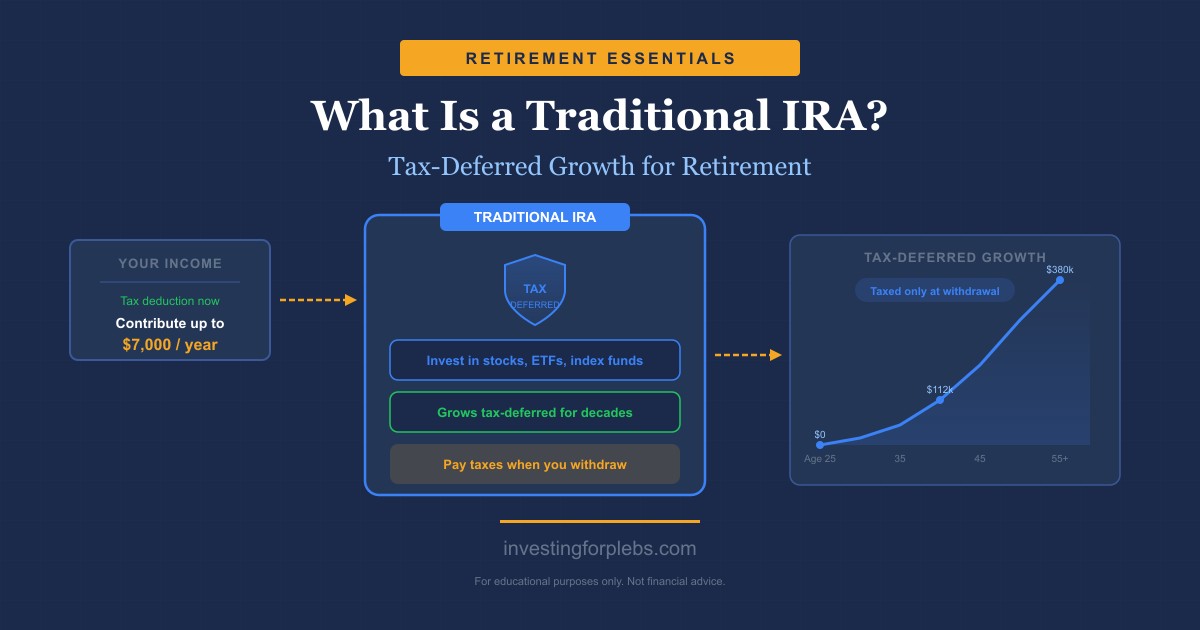
- Roll it over to an IRA (an Individual Retirement Account gives you more investment choices than most employer plans, and it’s a popular option for the flexibility it offers).
The critical thing: if you take the money out as cash (a “distribution”), you’ll owe income taxes on the whole amount plus a 10% early withdrawal penalty if you’re under age 59½. That can wipe out a significant chunk of what you saved. Avoid this unless it’s a genuine emergency.
What to Actually Invest In
Once you’ve set your contribution amount, you’ll need to pick investments from your plan’s menu. Most people don’t spend nearly enough time here.
A few principles:
- Low-cost index funds are your friend. Most plans offer at least one S&P 500 or total stock market index fund. These track broad market indexes with minimal fees. Look for funds with expense ratios under 0.10% if possible.
- Watch the fees. A fund charging 1% per year sounds small, but over 30 years it can cost you tens of thousands of dollars in compounding you never got. Understanding compound interest makes this concrete.
- Target-date funds are a reasonable default. These are “set it and mostly forget it” funds (they automatically adjust your mix from stocks to bonds as you approach retirement). They’re not optimal, but they’re much better than leaving your money in a default money market account.
- Diversification matters. A mix of index funds and ETFs covering different market segments gives you broad exposure without concentrating risk in any single area.
On bonds within your 401(k): if your plan includes bond fund options, corporate bond funds are generally preferable to government bond funds, which carry inflation and currency risk that traditional financial advice tends to understate.
Common 401(k) Mistakes
Not contributing enough to capture the full employer match. This is leaving money on the table, full stop. Always contribute at least enough to get every dollar of your employer’s match before putting money anywhere else.
Ignoring the investment options. Your contributions sitting in a default money market fund earning near zero is not a 401(k) working for you. Pick an actual investment.
Choosing high-fee funds when cheaper options exist. Check the expense ratio on every fund in your plan. A few basis points adds up to real money over decades.
Cashing out when you change jobs. The tax hit and penalty make this a costly choice except in genuine financial emergencies.
Never increasing your contribution rate. If you started at 3% and got three raises since then, bump up your contribution rate. Most people never revisit it.
How to Get Started
- Log into your employer’s benefits portal and confirm whether a 401(k) is available.
- Find your employer match formula and set your contribution at at least the percentage required to capture the full match.
- Choose your investments. If you don’t know where to start, a low-cost target-date fund or an S&P 500 index fund is a reasonable starting point.
- Increase your contribution over time. A common strategy: every time you get a raise, increase your contribution rate by 1–2%. You won’t miss money you never saw.
The 401(k) isn’t exciting. It doesn’t have the thrill of picking individual stocks or following the market daily. But for most working Americans, it’s the single most impactful retirement tool available — especially when your employer is matching your contributions.
Use it.
This content is for educational purposes only and does not constitute financial advice. investingforplebs.com is not a registered investment advisor. Please consult a qualified financial professional before making investment decisions.


Leave a Reply